Table of Contents
Introduction
.jpg)
Melamine-faced panels are widely used in modern furniture manufacturing because they combine a decorative finished surface with an engineered wood core that can move directly into cutting, drilling, edge banding and assembly.
However, “melamine board” does not refer to one single material. The decorative melamine surface can be applied to different substrates, with MDF and particle board being two of the most common choices for furniture and interior applications.
For furniture manufacturers, cabinet factories, wholesalers and project buyers, the important question is therefore not simply whether to use melamine panels. The real decision is whether melamine-faced MDF or melamine-faced particle board provides the better core for a particular component, manufacturing process and end-use environment.
DA AO Wood supplies engineered wood panels for furniture and interior applications, including MDF and melamine faced particleboard. Selecting the correct substrate can help manufacturers balance machining quality, decorative appearance, hardware performance and production efficiency.
Quick Answer: Melamine MDF or Particle Board?
Melamine MDF is generally the stronger choice when furniture components require detailed machining, CNC routing, cleaner profiled edges or a dense and uniform core beneath the decorative surface.
Melamine particle board is often the more practical option for large-volume cabinet carcasses, wardrobes, office furniture, shelving and standardized panel furniture where straight cutting, drilling, edge banding and efficient material use are more important than decorative machining.
For many furniture factories, the most efficient solution is not choosing one substrate for every component. MDF may be used where machining performance matters, while melamine particle board can be used for large flat carcass panels and other standardized components.
Melamine MDF vs Melamine Particle Board at a Glance
| Factor | Melamine MDF | Melamine Particle Board |
|---|---|---|
| Core Structure | Fine wood fibers | Compressed wood particles |
| Surface Appearance | Depends mainly on melamine décor | Depends mainly on melamine décor |
| Core Uniformity | Very high | Good with controlled production |
| CNC Routing | Better suited | More limited for detailed routing |
| Straight Cutting | Excellent | Excellent |
| Drilling | Excellent | Excellent with correct tooling |
| Edge Profiling | Better suited | Usually designed for edge banding |
| Edge Banding | Excellent | Excellent |
| Screw Holding | Depends on density and hardware | Depends heavily on density and hardware |
| Panel Weight | Often higher | Often lower depending on specification |
| Cabinet Carcasses | Suitable | Very common |
| Wardrobes | Suitable | Very common |
| Decorative Routed Parts | Excellent | Less suitable |
| Mass Production | Good | Excellent |
| Cost Efficiency | Usually higher material cost | Often more economical |
| Best Selection Basis | Machining and finish requirements | Production efficiency and flat-panel use |
The decorative melamine surface can make the two panels look very similar after installation. The important differences are hidden inside the board.
What Is Melamine MDF?
-3.jpg)
Melamine MDF consists of a medium-density fiberboard core with a decorative melamine surface bonded to one or both faces.
MDF itself is produced from refined wood fibers that are bonded and compressed into a relatively homogeneous panel. This fine internal structure makes MDF suitable for applications where consistent machining is important.
The general structure of medium-density fiberboard helps explain why MDF performs differently from particle board during routing, profiling and edge processing.
Adding a melamine decorative surface gives manufacturers a ready-finished board while retaining the relatively uniform MDF core.
Common applications can include:
- Wardrobe doors
- Cabinet panels
- Decorative furniture components
- Retail fixtures
- Shelving
- Interior panels
- Furniture fronts
- CNC-machined components
DA AO Wood’s MDF panel range provides a substrate option for furniture manufacturers that require a fine and relatively consistent engineered wood core.
What Is Melamine Particle Board?
Melamine particle board uses particle board as the substrate rather than MDF.
The core is manufactured from wood particles combined with resin and pressed into a panel. A decorative melamine layer is then bonded to the surface.
DA AO’s Melamine Faced Particleboard is specifically positioned for furniture, cabinetry and interior applications. The current product information lists a 1220 × 2440 mm format and thickness options from 15 mm to 25 mm.
Particle board is especially effective for high-volume furniture components that are predominantly rectangular and processed through panel saws, drilling equipment and edge-banding lines.
Typical uses include:
- Wardrobe carcasses
- Kitchen cabinet bodies
- Office furniture
- Storage cabinets
- Bookcases
- Shelving
- Desks
- Retail furniture
- Hotel casegoods
- Ready-to-assemble furniture
The general construction of particle board explains its difference from MDF: its core is based on discrete wood particles rather than refined fibers.
The Melamine Surface Is Only Part of the Panel
One of the most important purchasing lessons is that the visible surface does not tell you everything about the panel.
Two boards may use almost identical wood-grain melamine paper and therefore look nearly the same from the outside.
However, underneath that decorative surface, the substrate can influence:
- Cutting behavior
- Edge quality
- Routing performance
- Screw holding
- Panel weight
- Hardware performance
- Production efficiency
- Total material cost
This is why furniture buyers should specify both the decorative surface and the core material.
Simply asking for:
“White melamine board”
is rarely sufficient for a serious production order.
A more useful specification would define the core, thickness, dimensions, décor, texture, edge requirements, application and target market.
1. Core Structure: The Main Difference
The biggest difference between the two products is inside the panel.
MDF is based on fine fibers.
Particle board is based on larger wood particles.
This affects how the substrate behaves when it is cut, drilled or routed.
Because MDF has a more homogeneous internal structure, it is generally better suited to furniture components requiring detailed CNC machining or shaped edges.
Particle board is particularly efficient when furniture production consists mainly of:
- Straight cutting
- Drilling
- Edge banding
- Hardware installation
- Assembly
Neither structure is automatically better. They are optimized for different manufacturing priorities.
2. Surface Appearance Can Be Very Similar
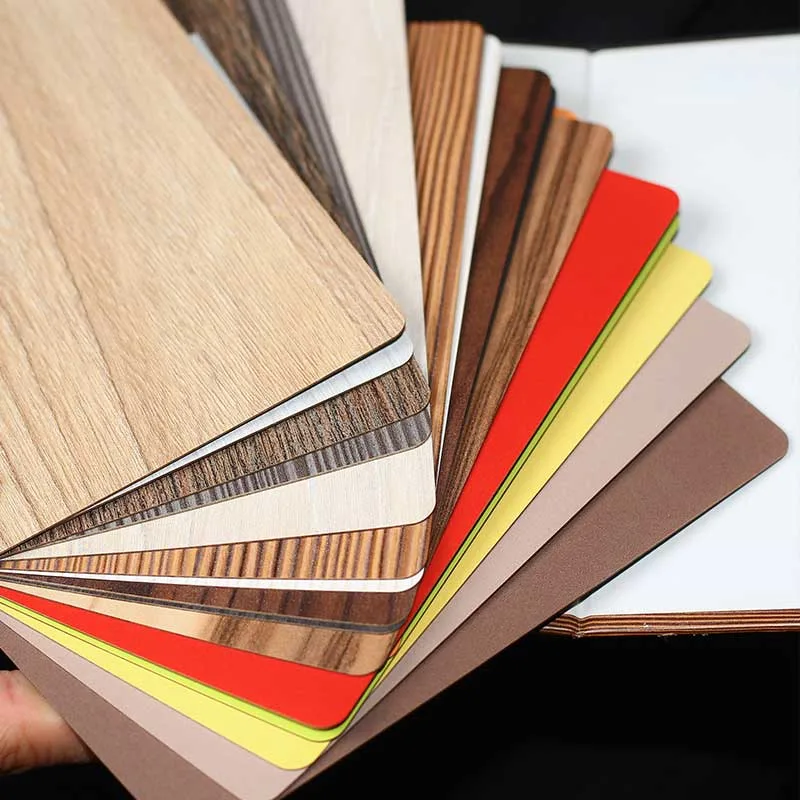
Once both panels are faced with the same melamine décor, their finished appearance can be remarkably similar.
The visible surface may reproduce:
- Oak grain
- Walnut grain
- Ash
- Maple
- Concrete effects
- Stone effects
- Solid colors
- Textile textures
- Matte finishes
This means customers often cannot identify the core material simply by looking at the finished furniture surface.
For manufacturers, that creates an opportunity to select the substrate according to technical requirements rather than appearance alone.
A cabinet interior panel, for example, may not require the machining characteristics of MDF even when its decorative appearance must perfectly match an MDF door or another furniture component.
3. CNC Machining Favors MDF
If decorative machining is an important part of the product design, MDF usually provides greater flexibility.
Furniture manufacturers increasingly use CNC equipment to produce:
- Grooves
- Routed patterns
- Recessed details
- Decorative channels
- Shaped components
- Furniture fronts
MDF’s relatively uniform core allows tooling to pass through the material more consistently.
Particle board is better suited to standard panel processing than deep decorative routing because exposing or machining through the particle-based core may produce a rougher edge or internal surface.
Therefore:
Choose melamine MDF when the substrate itself needs to become part of the decorative machining process.
Choose melamine particle board when the board mainly remains a flat finished panel.
4. Edge Banding Performance Matters
Most melamine furniture panels require edge banding after cutting.
This means the core is exposed along the cut edge before PVC, ABS, veneer or another edge material is applied.
Successful edge banding depends on:
- Clean cutting
- Consistent panel thickness
- Stable edges
- Correct adhesive
- Machine settings
- Banding material
- Production speed
Both MDF and particle board can perform well on industrial edge-banding lines when appropriate quality panels and correct processing conditions are used.
However, manufacturers should test actual panels rather than relying only on material names.
Two particle boards with the same nominal thickness may behave differently because of variations in internal density and production quality.
The same principle applies to MDF.
5. Screw Holding Depends on More Than the Core Name
Furniture buyers frequently ask whether MDF or particle board holds screws better.
There is no useful purchasing answer without considering the entire connection system.
Hardware performance can depend on:
- Core density
- Board thickness
- Screw diameter
- Screw length
- Fastener design
- Pilot-hole diameter
- Edge distance
- Installation torque
- Number of assembly cycles
- Furniture load
A high-quality panel paired with unsuitable hardware can still produce poor results.
For wardrobes, cabinets and ready-to-assemble furniture, buyers should test hinges, drawer runners, cam connectors, shelf supports and other hardware with the actual production board.
The panel and hardware should be treated as one system.
6. Particle Board Often Makes Sense for Carcasses
Cabinet and wardrobe carcasses are usually made from relatively large rectangular panels.
These components generally require:
- Flatness
- Consistent thickness
- Clean cutting
- Accurate drilling
- Good edge banding
- Repeatable color
- Reliable hardware installation
They usually do not require deep decorative routing.
This makes melamine particle board particularly suitable for many carcass applications.
DA AO describes its melamine faced particleboard as compatible with secondary processing such as cutting, edge banding and drilling, while also emphasizing consistency of thickness, flatness, density balance and surface quality across production batches.
For a factory producing thousands of wardrobe or cabinet panels, these repeatable processing characteristics can be more important than decorative machining capability.
7. MDF Can Add Value to More Complex Components
MDF becomes more attractive when furniture design moves beyond simple rectangular panels.
Examples include:
- Decorative doors
- Routed fronts
- Grooved wall panels
- Shaped shelves
- Furniture moldings
- Feature panels
- Custom retail furniture
Even when the final board uses a decorative surface, the uniform MDF core can provide more flexibility during secondary processing.
Furniture manufacturers should therefore consider whether a component will remain flat throughout production or whether its edges and internal structure will be machined as part of the design.
8. Compare Total Manufacturing Cost, Not Sheet Price
One of the easiest purchasing mistakes is comparing only the price per sheet.
Particle board is often more economical than MDF, which is one reason it is widely used in mass-produced furniture.
However, the true comparison should be:
Total cost per finished furniture component.
That includes:
- Panel cost
- Cutting waste
- Tool wear
- Production speed
- Edge banding
- Reject rate
- Hardware performance
- Panel weight
- Packaging
- Transport
- Rework
Using MDF where its machining advantages are unnecessary can increase material cost.
Using a lower-specification particle board where higher edge or machining performance is required can increase production problems.
The correct target is not the cheapest panel. It is the lowest efficient total manufacturing cost while maintaining the required finished quality.
Which Is Better for Kitchen Cabinets?
For kitchen furniture, both materials can have useful roles.
Melamine particle board is frequently suitable for:
- Cabinet side panels
- Interior shelves
- Cabinet dividers
- Base cabinet carcasses
- Tall cabinet structures
Melamine MDF may be selected where the design or processing requirements justify a denser, more uniform substrate.
If painted or deeply routed cabinet doors are required, raw or appropriately finished MDF may be a better choice than either flat melamine-faced option.
The important point is that a complete kitchen does not need to use one substrate throughout.
Different components can be specified according to their actual function.
Which Is Better for Wardrobes?
Wardrobes are one of the strongest applications for melamine-faced panels.
Large areas of flat panels make production efficiency particularly important.
For standard wardrobe carcasses, melamine particle board is often a practical starting point because the components primarily require cutting, drilling and edge banding.
MDF may become more attractive for:
- Decorative doors
- Routed components
- Premium fronts
- Complex shapes
- Special furniture details
Using both substrates within one wardrobe collection can help manufacturers balance appearance, performance and cost.
Which Is Better for Office Furniture?
Office furniture production commonly uses repetitive rectangular panels for:
- Desks
- Workstations
- Cabinets
- Filing units
- Bookcases
- Partitions
- Shelving
This makes melamine particle board a logical material for many office furniture systems.
Where premium furniture fronts, decorative shapes or specialized machining are required, MDF can be introduced selectively.
Again, component-based material selection usually makes more sense than choosing one core for every product.
Which Is Better for Retail and Commercial Interiors?
Commercial interiors can include very different performance requirements.
A simple storage cabinet may use melamine particle board efficiently.
A highly customized display fixture may require MDF because CNC machining and complex shapes form part of the design.
Project buyers should therefore divide commercial furniture into categories such as:
- Flat carcass components
- Decorative visible components
- Load-bearing sections
- High-contact surfaces
- Custom-shaped elements
Each group can then be assigned the most appropriate substrate.
Do Melamine Panels Resist Moisture?
-3.jpg)
This question requires careful terminology.
A melamine surface can help protect the faces of a panel during normal interior use, but it does not automatically make the entire board waterproof.
Edges, drilled holes, cut-outs and damaged surfaces can expose the substrate.
Performance therefore depends on:
- Core grade
- Surface integrity
- Edge banding
- Installation
- Exposure conditions
- Duration of moisture contact
For kitchens, bathrooms and humid environments, buyers should define the required moisture performance before ordering instead of assuming that every melamine panel is suitable for wet conditions.
Formaldehyde Requirements Matter for Export Furniture
For international furniture manufacturers and panel importers, core selection is also linked to regulatory compliance.
The U.S. Environmental Protection Agency regulates hardwood plywood, MDF and particle board under the Formaldehyde Emission Standards for Composite Wood Products. The requirements also affect certain finished goods containing these materials.
Furniture manufacturers selling into the United States can review the EPA Formaldehyde Emission Standards for Composite Wood Products when defining purchasing requirements.
This is a good example of why a professional purchase specification needs more than:
“18 mm melamine board.”
Depending on the market, buyers may need to identify:
- Core type
- Required emission standard
- Certification
- Thickness
- Surface décor
- Application
- Packaging
- Documentation
Regulatory requirements should always be confirmed for the final destination market.
What Should B2B Buyers Check Before Ordering?
For bulk melamine panel purchasing, the following factors deserve particular attention.
| Purchasing Factor | Why It Matters |
|---|---|
| Core Material | Determines machining and structural behavior |
| Thickness | Affects hardware, weight and furniture structure |
| Thickness Tolerance | Important for edge banding and automated production |
| Density | Influences machining and fastening performance |
| Panel Flatness | Critical for cabinets and large furniture panels |
| Melamine Décor | Determines final appearance |
| Texture | Influences visual and tactile finish |
| Color Consistency | Important across multiple production batches |
| Surface Defects | Can increase rejects |
| Edge Quality | Important after panel cutting |
| Hardware Compatibility | Affects furniture assembly |
| Emission Requirement | Important for regulated markets |
| Packaging | Protects decorative surfaces during transport |
For large-volume purchasing, repeatability is often more important than the appearance of one sample sheet.
Why Batch Consistency Matters
Furniture factories typically set cutting equipment, drilling programs and edge-banding machines according to a particular panel specification.
If thickness, density or flatness changes significantly between batches, manufacturers may need to adjust equipment more frequently.
Variation can also affect:
- Cabinet alignment
- Edge-banding appearance
- Hardware installation
- Furniture assembly
- Packing dimensions
DA AO’s particle board product information emphasizes standardized production and control over thickness, flatness, density balance and surface quality, reflecting the requirements of industrial furniture processing.
For repeat orders, buyers should therefore evaluate consistency rather than judging the supplier only from the first shipment.
Common Mistakes When Buying Melamine Panels
Choosing Only by Décor
A beautiful wood-grain surface does not tell you whether the substrate is suitable for your production process.
Always evaluate the core.
Comparing Only Price Per Sheet
The lowest sheet price can be misleading if cutting, edge banding or hardware performance creates higher downstream costs.
Failing to Define the Application
“Furniture use” is too broad.
Tell the supplier whether the panel will become a wardrobe side, cabinet shelf, desk, door, decorative front or retail fixture.
Ignoring Edge Processing
Melamine furniture almost always exposes cut edges during manufacturing.
The quality of those edges can directly affect edge-banding performance.
Assuming Melamine Means Waterproof
A decorative surface does not automatically protect exposed edges, holes and cut-outs.
Ordering Before Testing Hardware
Confirm how hinges, screws and connectors behave in the intended substrate before large-scale production.
How to Choose Between Melamine MDF and Particle Board
A practical decision can begin with five questions.
Will the component require decorative routing or complex machining?
If yes, MDF deserves stronger consideration.
Will the component remain a flat rectangular panel?
Particle board may provide a more efficient solution.
Is the component primarily a cabinet or wardrobe carcass?
Melamine particle board is often a logical starting point.
Does the design require a denser and more homogeneous core?
MDF may provide advantages.
Is minimizing total production cost a major requirement?
Evaluate particle board first, but calculate the complete manufacturing process rather than material price alone.
The final decision should be verified through samples and production testing.
FAQ
Is melamine MDF better than melamine particle board?
Not for every application. Melamine MDF is often preferable for detailed machining and applications requiring a more uniform core. Melamine particle board is highly practical for flat furniture components, cabinet carcasses, wardrobes and high-volume manufacturing.
Is melamine particle board good for cabinets?
Yes. It is widely suited to cabinet carcasses, shelves, partitions and other flat components when the correct thickness, grade, hardware and edge treatment are selected.
Can melamine MDF be CNC routed?
MDF’s fine and relatively uniform fiber structure generally makes it suitable for CNC machining. However, manufacturers should consider how routing affects the decorative surface and whether exposed areas require additional finishing.
Is melamine board waterproof?
Melamine-faced panels should not automatically be considered waterproof. The surface can provide protection in normal interior use, but exposed edges, drilled holes and cut-outs can allow moisture to reach the substrate.
Which is better for wardrobes?
Melamine particle board is often efficient for wardrobe carcasses and standardized flat panels. MDF can be useful for decorative fronts, routed elements and components requiring more detailed machining.
What thickness should I choose?
Thickness should be selected according to the furniture component, load, span, hardware and structural design. Shelves, doors, side panels and backs may require different specifications.
Conclusion
The difference between melamine MDF and melamine particle board is not primarily visible on the finished surface. It is found in the core and in how that core behaves during manufacturing and use.
Melamine MDF offers advantages when furniture components require a fine, uniform substrate and more complex machining.
Melamine particle board is particularly effective for standardized flat furniture components where cutting, drilling, edge banding and high-volume production efficiency are priorities.
For many furniture manufacturers, the strongest solution is a combination of materials rather than one universal panel.
DA AO Wood provides particle board solutions together with MDF and other engineered wood panels for furniture manufacturing and interior applications. The current product range includes melamine-faced particleboard designed for furniture, cabinetry and large-volume panel processing.
For a furniture line, cabinet project or distribution program, buyers can use the DA AO Wood Contact Us page to provide the required core type, dimensions, thickness, décor, application, quantity and destination market so the panel specification can be matched more accurately to the project.