Table of Contents
Choosing between MDF and particle board is not simply a question of which material is “better.” For furniture manufacturers, cabinet factories, importers, distributors, and project buyers, the right choice depends on how the panel will be processed, finished, assembled, transported, and used.
Both materials belong to the engineered wood panel family, but their internal structures are very different. Medium-density fiberboard (MDF) is manufactured primarily from refined wood fibers bonded under heat and pressure, while particle board uses wood particles combined with binders and pressed into panels. These structural differences influence machining quality, surface smoothness, screw holding, weight, price, finishing options, and suitability for different furniture components.
For furniture production, the most useful approach is therefore not to ask, “Is MDF better than particle board?” but rather, “Which panel provides the right balance of performance, processing efficiency, appearance, and cost for this particular furniture component?”
DA AO Wood manufactures both MDF panels and particle board solutions, allowing manufacturers and project buyers to select materials according to the actual requirements of their furniture production rather than forcing one material into every application.
MDF or Particle Board for Furniture?
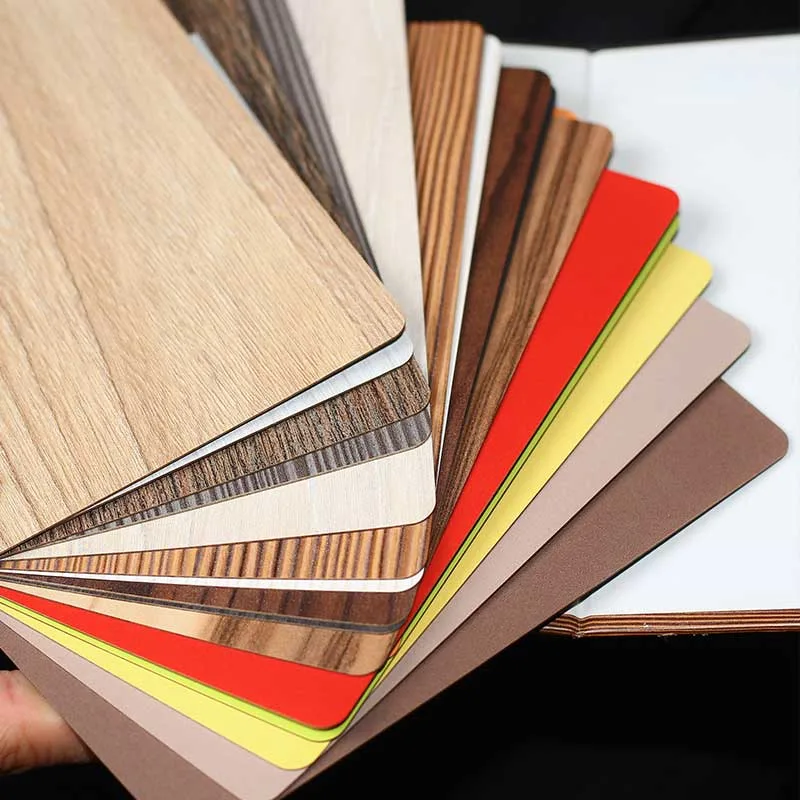
For furniture components requiring a smooth painted surface, detailed CNC routing, decorative profiles, or refined edge machining, MDF is usually the more suitable option because of its fine and relatively uniform fiber structure.
For high-volume furniture where cost efficiency, flat laminated surfaces, and standardized cabinet or wardrobe components are priorities, particle board can be an economical and practical choice, particularly when supplied with a melamine surface.
In practical furniture production:
- MDF is often preferred for painted cabinet doors, decorative fronts, routed panels, moldings, and CNC-machined components.
- Particle board is widely suited to wardrobe carcasses, cabinet bodies, shelving, desks, storage furniture, and melamine-faced furniture components.
- Neither material should be selected by price alone. Density, panel thickness, surface quality, moisture requirements, hardware design, finishing method, and consistency between production batches should all be evaluated.
MDF vs Particle Board at a Glance
| Factor | MDF | Particle Board |
|---|---|---|
| Internal Structure | Fine wood fibers | Compressed wood particles |
| Surface Smoothness | Excellent | Good, especially when laminated |
| CNC Routing | Excellent | More limited for detailed routing |
| Painted Finish | Excellent | Usually less suitable for premium direct painting |
| Melamine Lamination | Excellent | Excellent |
| Edge Machining | Clean and consistent with correct tooling | Requires appropriate tooling and edge treatment |
| Screw Holding | Moderate to good depending on density and hardware | Depends strongly on density, screw type, and design |
| Cost Efficiency | Medium | Generally more economical |
| Cabinet Carcass Use | Good | Very common |
| Decorative Door Use | Excellent | More limited |
| Wardrobe Production | Excellent | Excellent |
| High-Volume Furniture | Good | Excellent |
| Moisture Performance | Depends on board grade | Depends on board grade |
| Surface Consistency | Very high | High with quality production |
The table shows why furniture factories commonly use more than one panel type. MDF may be selected for a door front while melamine-faced particle board is used for the cabinet body. The best material specification therefore often involves combining panels according to each component’s function.
What Is MDF?
-3.jpg)
MDF, or medium-density fiberboard, is an engineered wood panel produced from wood fibers combined with resin and consolidated under heat and pressure. Because the raw material has been broken down into relatively fine fibers, the finished board has a much more homogeneous internal structure than particle board.
This uniformity is one of the main reasons MDF performs well during routing, profiling, sanding, drilling, painting, veneering, and other decorative processes.
According to the general technical description of medium-density fiberboard, MDF is commonly used for cabinetry, furniture, joinery, flooring, and interior applications because its structure allows relatively consistent machining and surface finishing.
For manufacturers requiring controlled specifications, DA AO’s MDF Medium Density Fiberboard is available in a standard 1220 × 2440 mm sheet size with thickness options from 2.5 mm to 30 mm and stated density options of 600–750 kg/m³, creating flexibility for different furniture and interior applications.
What Is Particle Board?
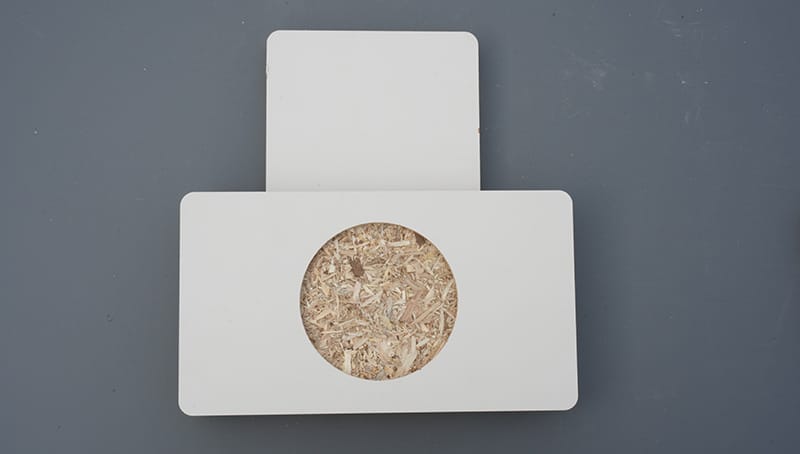
Particle board is another engineered wood product, but instead of refined fibers, its structure is based on wood particles bonded and compressed into panel form.
This manufacturing approach can provide a flat, consistent panel with good material utilization and competitive cost, making particle board especially attractive for large-volume furniture production.
Particle board is frequently used beneath decorative surfaces such as melamine paper, laminates, and veneers. In this form, the core provides the panel structure while the decorative surface supplies the required appearance and surface performance.
For example, DA AO’s Melamine Faced Particleboard is designed for indoor applications and is available in a 1220 × 2440 mm format with 15–25 mm thickness options. The product combines a particle board core with a melamine-coated surface, making it suitable for applications where both production efficiency and decorative consistency are important.
MDF vs Particle Board: Key Differences
Understanding the difference between the two panels becomes much easier when the comparison is connected to actual furniture manufacturing operations.
1. Surface Smoothness and Finishing
One of MDF’s strongest advantages is its smooth and uniform surface.
Because the board consists of fine fibers rather than larger particles, a well-manufactured MDF panel provides a suitable substrate for:
- Painting
- Priming
- Veneering
- Melamine finishing
- PVC or decorative film applications
- CNC routing
- Decorative profiling
This is why MDF is frequently associated with painted cabinet doors, decorative panels, furniture fronts, wall features, and other components where the finished surface remains visually important.
Particle board, by comparison, is particularly effective when the finished furniture uses a laminated or melamine-faced surface. Once the decorative layer has been applied correctly, particle board can provide the clean and standardized appearance required for large furniture production runs.
For buyers, the key distinction is therefore:
Choose MDF when the core itself must support detailed machining and finishing. Choose melamine particle board when the decorative surface is already integrated into the panel specification and production efficiency is the priority.
2. CNC Machining and Decorative Profiles
Modern furniture production increasingly depends on CNC routers, automated drilling systems, panel saws, nesting lines, and other precision equipment.
MDF is especially useful for CNC processing because its relatively uniform fiber structure allows cutters to move through the panel without encountering large internal particles. This makes MDF suitable for decorative cabinet doors, grooved panels, routed wall panels, furniture fronts, moldings, and shaped components.
Particle board can also be processed efficiently on modern panel furniture production lines, but it is normally more appropriate for straight cuts, drilling, edge banding, and standardized panel components than for deeply routed decorative profiles.
For example, a wardrobe factory may use particle board for the cabinet carcass while selecting MDF for decorative doors.
Using both materials strategically can reduce unnecessary material cost without sacrificing the visual quality of the finished product.
3. Screw Holding and Hardware Performance
Screw holding is more complicated than simply saying that one board is strong and the other is weak.
Hardware performance can be influenced by:
- Panel density
- Panel thickness
- Screw diameter
- Screw length
- Pilot-hole design
- Distance from panel edges
- Fastener type
- Number of assembly cycles
- Furniture loading
- Manufacturing quality
For mass-produced furniture, this matters because hinges, drawer slides, connectors, shelves, and mounting hardware can place repeated stress on the panel.
MDF’s relatively uniform internal structure can provide predictable machining, but correct screws and drilling parameters remain important.
Particle board can perform effectively in ready-to-assemble and panel furniture when density, thickness, fasteners, and connection design are properly matched. Manufacturers should therefore test actual hardware systems rather than selecting boards based only on generic material descriptions.
4. Painted Furniture and Cabinet Doors
For painted furniture, MDF is generally the preferred choice.
A smooth surface helps reduce the amount of preparation required before coating, while the uniform core supports routed profiles and decorative shapes.
Typical applications include:
- Painted kitchen cabinet doors
- Bathroom vanity doors
- Decorative drawer fronts
- Routed wardrobe doors
- Furniture panels with grooves
- Interior wall features
- Decorative molding components
A manufacturer producing shaker-style cabinet doors, for example, usually requires more than basic sheet strength. The material must also machine cleanly and create a surface capable of accepting primer and paint consistently.
These requirements are where MDF offers a particularly strong advantage.
5. Melamine Furniture Production
Particle board becomes especially competitive when the furniture design uses a melamine-faced surface.
Melamine-faced particleboard can arrive at the furniture factory with the decorative surface already applied. Manufacturers can then move directly into cutting, drilling, edge banding, assembly, and packaging operations.
This can be particularly attractive for:
- Wardrobes
- Kitchen cabinet carcasses
- Office furniture
- Storage cabinets
- Shelving systems
- Retail fixtures
- Apartment furniture
- Student accommodation furniture
- Hotel casegoods
DA AO states that its panel production controls parameters including thickness, flatness, density balance, and surface quality to improve consistency across production batches—factors that are especially important when panels enter repetitive industrial furniture workflows.
6. Cost and Large-Scale Production
Particle board is generally selected when cost control is an important part of the furniture specification.
However, professional buyers should evaluate total production cost, not simply panel price.
A cheaper board can become expensive if it results in:
- Excessive cutting waste
- Chipped edges
- More frequent machine adjustments
- Poor edge-banding results
- Hardware failures
- Surface inconsistency
- Batch-to-batch thickness variation
- Increased rejection rates
Similarly, using higher-cost MDF for every component may unnecessarily increase the material cost of furniture that does not require MDF’s machining characteristics.
The best approach is component-based material selection.
Use the more suitable panel where its performance creates value, rather than specifying one material throughout the entire furniture item.
Which Panel Is Better for Different Furniture Applications?
| Furniture Application | Recommended Starting Point | Main Reason |
| Painted cabinet doors | MDF | Smooth surface and good routing performance |
| CNC decorative fronts | MDF | Uniform internal structure |
| Wardrobe carcasses | Melamine particle board / MDF | Flat panels and efficient production |
| Kitchen cabinet carcasses | Melamine particle board / MDF | Decorative surface and standardized processing |
| Office desks | Melamine particle board | Cost-efficient large-panel production |
| Decorative wall panels | MDF | Excellent machining and finishing |
| Drawer fronts | MDF | Suitable for painting and profiling |
| Storage furniture | Particle board | Good balance of cost and function |
| Retail fixtures | MDF / particle board | Depends on finish and design |
| Hotel furniture | MDF / particle board / plywood | Depends on component and performance requirements |
| Shelves | MDF / particle board | Span, load, thickness, and support must be considered |
| Premium structural components | Plywood may be considered | Higher structural requirements may favor another panel type |
The last point is important. MDF and particle board are not the correct solution for every furniture component.
Where higher structural strength, repeated fastening, or other demanding performance requirements are involved, buyers may also consider DA AO’s broader wood panel range, including plywood and other panel products.
MDF vs Particle Board for Kitchen Cabinets
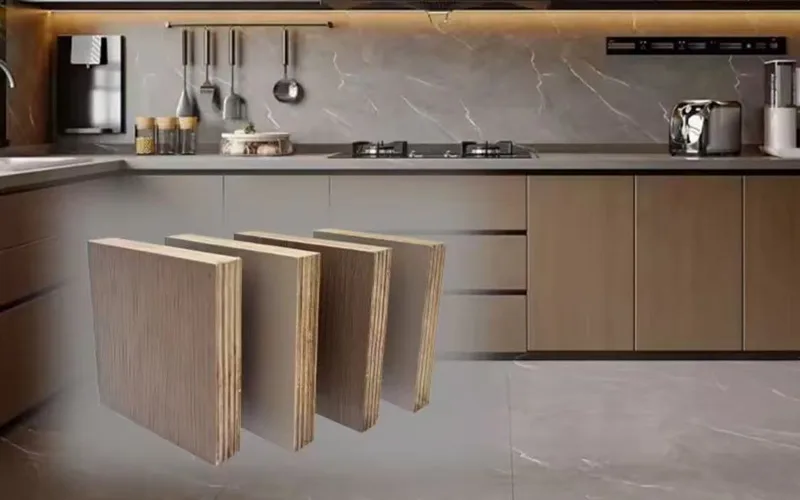
Kitchen cabinets illustrate why the decision should be component-specific.
A single kitchen may contain:
- Cabinet doors
- Side panels
- Shelves
- Backs
- Drawer fronts
- Drawer components
- Decorative end panels
- Fillers
- Toe kicks
There is no technical reason why every component must use exactly the same panel.
For example, painted cabinet fronts may favor MDF, while melamine-faced particle board can be considered for standardized carcass components where the surface appearance is already supplied by the decorative melamine layer.
Moisture conditions must also be considered carefully.
Neither “MDF” nor “particle board” automatically tells the buyer whether a panel is suitable for humid conditions. Buyers must confirm the specific grade and moisture-performance requirements with the supplier instead of assuming that all products within one material category perform identically.
MDF vs Particle Board for Wardrobes
Wardrobes are frequently produced from large quantities of standardized panels, making cost, surface consistency, drilling accuracy, edge banding, and color matching particularly important.
Melamine particle board works well in many wardrobe systems because the decorative finish is already present and the panels can move efficiently through industrial cutting and assembly lines.
MDF becomes particularly valuable when wardrobe designs include:
- Painted doors
- Routed patterns
- Decorative grooves
- Shaped panels
- Premium surface finishes
- Complex CNC designs
For manufacturers offering several furniture price levels, using different panel specifications can also help create clear product positioning without completely changing the production system.
What About Moisture Resistance?
Moisture is one area where buyers should avoid overly simple online comparisons.
Standard MDF and standard particle board are generally intended for appropriate interior conditions. Moisture-resistant grades can be manufactured for applications where increased humidity resistance is required, but the exact product grade and specification must be confirmed.
Exposure to excessive moisture can cause dimensional changes in wood-based panels. Particle board in particular can be susceptible to swelling when moisture penetrates an inadequately protected panel.
Furniture producers should therefore pay attention to:
- Panel grade
- Edge sealing
- Surface lamination
- Edge banding
- Cut-outs around sinks or plumbing
- Storage conditions
- Transportation protection
- Final installation environment
In kitchens, bathrooms, laundries, and humid markets, these details can matter as much as the basic choice between MDF and particle board.
Formaldehyde and Compliance Considerations
International buyers should also consider the regulatory requirements of the market into which finished panels or furniture will be sold.
For example, the U.S. Environmental Protection Agency’s Formaldehyde Emission Standards for Composite Wood Products cover hardwood plywood, MDF, and particle board under TSCA Title VI. These requirements are particularly relevant for manufacturers and importers supplying composite wood panels or finished goods to the United States.
The important procurement lesson is that buyers should not ask only:
“Is this MDF?”
They should also clarify:
- Destination market
- Required emission standard
- Required testing or certification
- Panel grade
- Intended application
- Required documentation
Regulatory requirements vary between markets, so the exact compliance specification should be confirmed before mass production.
What Should B2B Buyers Check Before Ordering?
When sourcing MDF or particle board in volume, purchasing teams should evaluate more than the product name and nominal thickness.
A useful purchasing specification should include the following factors.
Panel Thickness and Tolerance
A nominal 18 mm panel is useful only when thickness remains sufficiently consistent for the intended production process.
Variation can affect:
- Edge banding
- Drilling
- Connector positioning
- Cabinet alignment
- Automated production equipment
Density and Internal Consistency
Density influences machining behavior, panel weight, fastening performance, and the overall feel of finished furniture.
For MDF in particular, buyers should confirm whether the proposed density range matches the intended use rather than assuming that every MDF panel is interchangeable.
Flatness
Flat panels are essential for cabinet doors, carcasses, wardrobes, long shelves, decorative wall systems, and automated furniture manufacturing.
Warped panels can create problems long before the furniture reaches the customer.
Surface Quality
Surface uniformity is important for:
- Painting
- Lamination
- Veneering
- Decorative paper
- Film pressing
Visible defects may increase rejection rates or require additional preparation.
Edge Quality
Furniture manufacturing frequently depends on edge banding.
A panel may appear acceptable from the surface but produce poor results after cutting if its internal structure is inconsistent.
Buyers should therefore inspect both panel faces and freshly cut edges.
Batch Consistency
For high-volume manufacturing, repeatability matters more than the quality of a single sample.
A board that performs well in one sample but changes significantly between containers can disrupt:
- CNC programs
- Edge-banding settings
- Hardware installation
- Color matching
- Production schedules
DA AO emphasizes standardized manufacturing and control of panel thickness, flatness, density balance, and surface quality across production batches, which reflects the importance of consistency for industrial users.
Common Mistakes When Choosing MDF or Particle Board
One of the biggest purchasing mistakes is choosing solely according to the lowest price per sheet.
The cheapest panel is not automatically the lowest-cost material after machining, rejects, labor, finishing, and warranty risks are considered.
Another common mistake is specifying only:
“18 mm MDF”
or:
“18 mm particle board.”
For serious B2B procurement, this description may be incomplete.
The buyer may also need to define:
- Size
- Density
- Surface finish
- Color or decorative paper
- Moisture requirement
- Emission requirement
- Application
- Packaging
- Quantity
- Destination
- Hardware requirements
Giving the manufacturer more information about the final furniture application allows the panel specification to be matched more accurately.
When Should You Choose MDF?

MDF is a strong candidate when your furniture requires:
- Painted surfaces
- CNC routing
- Decorative grooves
- Shaped furniture fronts
- Smooth surfaces
- Consistent machining
- Veneer or decorative finishing
- Premium cabinet doors
- Wall decoration components
DA AO offers MDF Medium Density Fiberboard for furniture, interior decoration, and related indoor panel applications, with multiple thickness options available for different production requirements.
When Should You Choose Particle Board?
Particle board deserves consideration when your project prioritizes:
- Cost-efficient panel furniture
- Melamine-faced surfaces
- Large-volume production
- Wardrobe carcasses
- Cabinet bodies
- Office furniture
- Storage furniture
- Standardized straight panel components
- Efficient cutting and edge-banding workflows
For buyers wanting a finished decorative panel rather than a raw core, Melamine Faced Particleboard can be especially useful for furniture and interior applications.
Can MDF and Particle Board Be Used Together?
Yes—and for many furniture manufacturers, this is the more practical question.
Furniture does not have to be “all MDF” or “all particle board.”
A cabinet manufacturer could use:
MDF for the painted door + melamine particle board for the carcass.
A wardrobe manufacturer could use:
MDF for decorative routed fronts + particle board for interior cabinet panels.
This approach allows the furniture producer to allocate performance and cost where they matter most.
It can also help manufacturers develop different product tiers without redesigning every element of their furniture system.
FAQ
Is MDF better than particle board for furniture?
MDF is generally better when furniture requires painted surfaces, CNC routing, detailed profiles, or smooth decorative finishing. Particle board is often preferable when cost efficiency, melamine surfaces, and high-volume panel furniture production are the main priorities. The best option depends on the furniture component rather than the furniture category alone.
Is MDF stronger than particle board?
The fine and relatively uniform structure of MDF gives it different mechanical and machining characteristics from particle board, and MDF is generally described as denser and stronger than conventional particle board. However, actual performance depends on panel density, thickness, grade, manufacturing quality, hardware, and loading conditions.
Which is better for kitchen cabinets, MDF or particle board?
MDF is commonly selected for painted or routed cabinet doors, while melamine-faced particle board can be highly suitable for cabinet carcasses and other standardized components. Moisture grade, edge sealing, hardware design, and local compliance requirements should also be considered.
Can particle board be used for wardrobes?
Yes. Melamine-faced particle board is widely suited to wardrobe carcasses, shelves, partitions, and other flat furniture components when the panel grade, thickness, hardware, and design are correctly selected.
What MDF thickness is best for furniture?
There is no single ideal thickness for every furniture product. Thin MDF may be used for backs and decorative components, while thicker boards are more suitable for doors, shelves, side panels, or structural furniture elements. DA AO’s MDF range lists thickness options from 2.5 mm to 30 mm, allowing specifications to be selected according to the application.
Is melamine particle board suitable for mass furniture production?
Yes. Its finished decorative surface, standardized dimensions, cost efficiency, and compatibility with cutting, drilling, and edge-banding operations make melamine particle board suitable for many industrial furniture applications.
Should I request samples before a bulk order?
For large orders, sample evaluation is strongly recommended. Buyers can use samples to verify dimensions, surface appearance, cutting performance, edge quality, drilling behavior, color, and compatibility with their own manufacturing equipment before confirming mass production.
Conclusion
The MDF vs particle board decision should never be reduced to a simple question of which material is superior.
For furniture manufacturers, MDF offers clear advantages when smooth finishing, painting, CNC routing, and decorative machining are required. Particle board provides strong value for cost-controlled, high-volume furniture production, especially when combined with a melamine surface.
In many cases, the most efficient furniture specification uses both.
The right purchasing decision should consider the final furniture component, panel thickness, density, surface, hardware, moisture exposure, production equipment, target market requirements, and total manufacturing cost.
DA AO Wood supplies a broader range of wood panel solutions including MDF, particle board, plywood, OSB, eco-friendly boards, and solid wood panels for furniture manufacturing, interior decoration, and project applications. The company’s website states that its manufacturing system places emphasis on panel thickness, flatness, density balance, surface quality, and production consistency for industrial applications.
If you are selecting MDF, particle board, or melamine-faced panels for a furniture production line, cabinet project, distribution business, or bulk import order, you can contact DA AO Wood with your required size, thickness, surface finish, application, quantity, and destination market to discuss an appropriate panel specification.
.jpg)