Table of Contents
Introduction
Particle wood board and MDF are two of the most commonly used engineered wood materials in furniture manufacturing and interior design. Both offer cost efficiency, versatility, and wide availability, but they differ significantly in structure, performance, and ideal applications.
Choosing between them depends on your project requirements such as strength, surface finish, moisture resistance, and budget. This guide provides a clear, practical comparison to help you make the right decision.
What Is Particle Wood Board
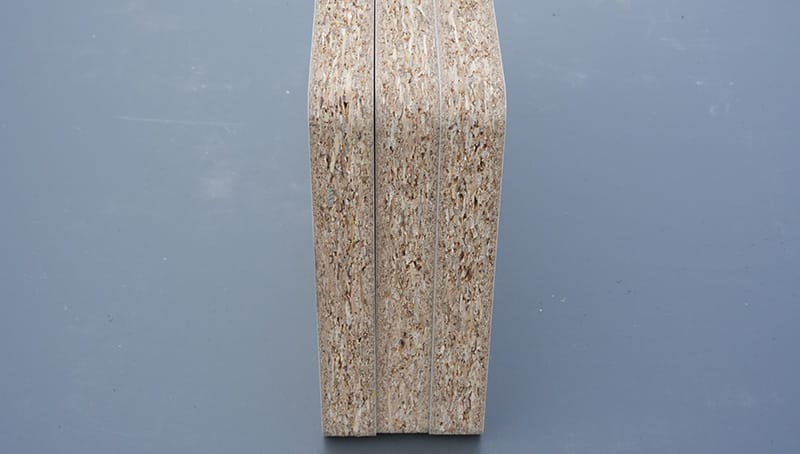
Wood particle board is an engineered wood product made from wood chips, sawdust, and resin adhesives, pressed under heat and pressure into flat panels.
It is widely used in furniture production due to its affordability and stable supply. The internal structure is less dense compared to MDF, which makes it lighter but also less strong in certain applications.
Wood particle board is commonly used for:
- Cabinet carcasses
- Shelving systems
- Budget furniture
- Interior partitions
Its main advantage is cost efficiency combined with acceptable performance for general use.
What Is MDF
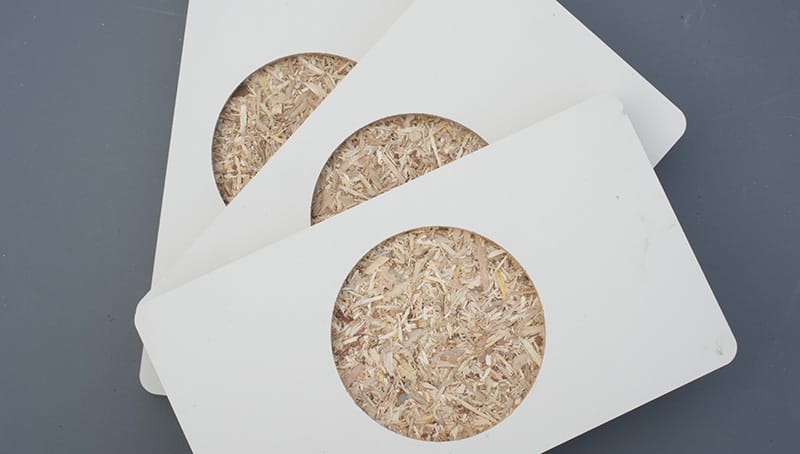
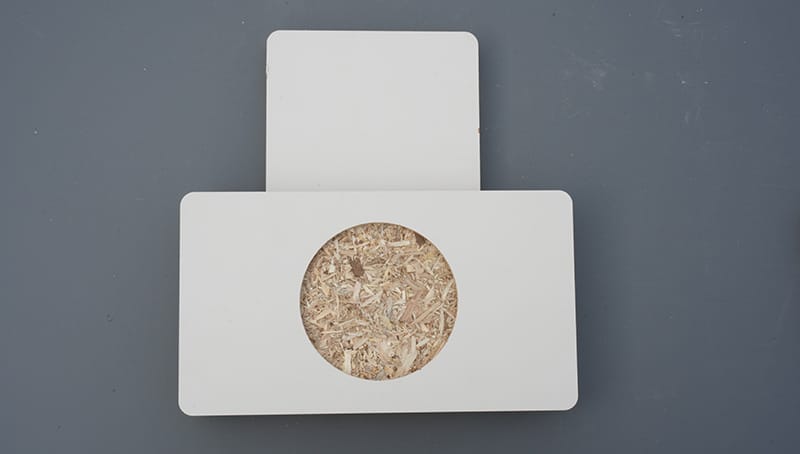
MDF (Medium Density Fiberboard) is made from fine wood fibers combined with resin and compressed into a dense, smooth board.
Compared to particle wood board, MDF has a more uniform structure, which makes it easier to machine, cut, and finish. It is especially popular for painted furniture and decorative applications.
MDF is commonly used for:
- Painted furniture surfaces
- Decorative panels
- Cabinet doors
- Interior molding and trim
Its smooth surface makes it ideal for high-quality finishes.
Key Differences Between Particle Wood Board and MDF
To understand which material is better, it is important to compare their core properties.
| Feature | Particle Wood Board | MDF |
|---|---|---|
| Density | Lower | Higher |
| Surface Finish | Rougher | Very smooth |
| Strength | Moderate | Higher |
| Moisture Resistance | Low to moderate | Moderate |
| Workability | Basic | Excellent |
| Cost | Lower | Slightly higher |
| Best Use | Structural furniture parts | Decorative and painted surfaces |
This comparison shows that neither material is universally better—it depends on application needs.
Strength and Durability Comparison
MDF generally offers higher density and better structural integrity compared to particle wood board. This makes MDF more suitable for applications requiring smooth edges and fine detailing.
Particle wood board, while adequate for many furniture structures, is more prone to edge chipping and has lower screw-holding strength.
However, in properly supported structures, wood particle board performs reliably for cost-sensitive projects.
Surface Quality and Finishing
Surface quality is one of the biggest differences between the two materials.
MDF has a smooth, uniform surface, making it ideal for painting, laminating, or veneering. It does not require extensive surface preparation.
Particle wood board has a more uneven surface, which typically requires laminates or veneers for a finished appearance.
For high-end visual results, MDF is usually preferred.
Moisture Resistance and Environmental Performance
Neither material is fully waterproof, but their resistance levels differ.
Particle wood board absorbs moisture more easily, which can lead to swelling if not properly sealed.
MDF performs slightly better due to its denser structure but still requires protection in humid environments.
For both materials, edge sealing and protective coatings are essential for long-term durability.
Workability and Manufacturing Efficiency
MDF is easier to machine, cut, and shape due to its uniform fiber structure. It allows for precise detailing, making it suitable for CNC machining and decorative designs.
Particle wood board is easier to produce and generally more cost-effective, but it is less suitable for fine detailing or complex shapes.
Manufacturers often choose based on production complexity and budget constraints.
Applications in Real Projects
Both materials are widely used in different segments of furniture production.
Particle Wood Board Applications
- Low-cost cabinets
- Storage furniture
- Interior partitions
- Basic shelving systems
MDF Applications
- Painted cabinet doors
- Decorative wall panels
- Modern furniture designs
- High-detail interior elements
Understanding application context helps determine the right material choice.
Which One Is Better for Your Project
There is no universal winner between wood particle board and MDF. The better choice depends on your priorities:
- Choose particle wood board if cost efficiency and structural simplicity are your main concerns
- Choose MDF if surface quality, precision, and design flexibility are more important
Many furniture manufacturers actually use both materials in different parts of the same product to balance cost and performance.
Industry Trends and Material Development
The demand for both materials continues to grow due to rising furniture production globally.
Recent trends include:
- Improved moisture-resistant particle boards
- Low-emission MDF products for better indoor air quality
- Increased use of recycled wood materials
- Growth of CNC-based precision furniture manufacturing
These innovations are improving both performance and sustainability.
Conclusion
Wood particle board and MDF each offer unique advantages. Understanding their differences allows designers, manufacturers, and buyers to make informed decisions that align with project goals.
By evaluating strength, surface quality, cost, and application needs, you can select the most suitable material for efficient and high-quality furniture production.
FAQ
What is a particle wood board?
A particle wood board is an engineered wood panel made from wood chips, sawdust, and resin. It is widely used in furniture manufacturing due to its low cost, stable structure, and suitability for cabinets, shelves, and interior furniture components.
How is particle wood board different from MDF?
Particle wood board is made from larger wood particles, while MDF uses fine wood fibers. MDF has a smoother surface and higher density, making it better for painting, while particle wood board is more cost-effective for structural furniture parts.
Is particle wood board strong enough for furniture?
Yes, particle wood board is suitable for many furniture applications such as cabinets and shelving. However, it has lower strength and screw-holding capacity compared to MDF or plywood, so proper support and design are important.
Can particle wood board be used in humid environments?
Standard particle wood board is sensitive to moisture and may swell if exposed to water. Moisture-resistant versions are available, but sealing edges and using protective coatings is necessary for better performance in humid conditions.
What are the main advantages of particle wood board?
The main advantages include low cost, wide availability, and ease of production. It is ideal for budget-friendly furniture projects where high-end surface finish or heavy structural strength is not the primary requirement.
Need Help Choosing the Right Particle Wood Board?
If you’re unsure which particle wood board is best for your furniture project, manufacturing needs, or budget requirements, our experts are here to help. Contact us today for a personalized consultation and get professional guidance on selecting durable, cost-effective, and reliable board solutions. Don’t wait until production begins—get in touch now to ensure your project achieves the right balance of performance, quality, and value!
.jpg)