Table of Contents
Medium Density Fiberboard 4×8: Cut Plans for Cabinet Shops
Medium density fiberboard 4×8 should be evaluated against a defined production task. For cabinet production, the priority is to allow for saw kerf and edge trimming before counting cabinet components. That turns a broad material search into a decision about the finished component, the process needed to make it and the evidence required before a repeat order.
This guide focuses on that specific buying situation. The useful next step is to calculate usable pieces from a full sheet. In particular, avoid an oversized offcut allowance hiding poor yield. A clear sample and written specification make it easier to compare medium density fiberboard 4×8 offers without relying on a surface photograph or an undefined quality claim.

The decision for cabinet production
Begin the medium density fiberboard 4×8 evaluation by separating the part requirement from the general product description. The medium density fiberboard 4×8 buyer needs to allow for saw kerf and edge trimming before counting cabinet components; the workshop needs a repeatable way to produce the approved result. Put those two responsibilities on one trial sheet with the component drawing, material identity and acceptance decision.
For cabinet production, use the final viewing position and the hardest production detail to define acceptance. Record what the supplied medium density fiberboard 4×8 sample represents and what it leaves unresolved. If a finish, hardware arrangement or service condition changes, revisit the relevant trial before assuming the original result still applies. The goal is a medium density fiberboard 4×8 order the receiving team can inspect and the workshop can reproduce.
Build the cutting plan from usable dimensions
Start with actual usable sheet size, then include trimming, saw kerf and any required grain or strength orientation. With medium density fiberboard 4×8, a diagram that fits nominal rectangles can overstate the real yield. Separate components that can be rotated from those whose direction is fixed by appearance or product requirements. Keep reusable offcuts identifiable rather than counting every remainder as future stock.
Run the same component list for each proposed sheet size and confirm that the workshop can handle the chosen format. Review narrow remnants and difficult corners with the operator before approving the plan. For medium density fiberboard 4×8, compare accepted component yield after machining, not only the number of rectangles on a screen. This links the material quotation to real production and makes any extra allowance for matched appearance or spare components visible.
Separate the fiber core from the decorative finish
MDF is made from wood fibers bonded into a panel. Its relatively fine, uniform structure supports detailed machining and smooth decorative finishes. When specifying medium density fiberboard 4×8, identify the substrate and facing separately. A painted board, a veneered board and a melamine-faced board may share a core family while needing different edge preparation and production settings.
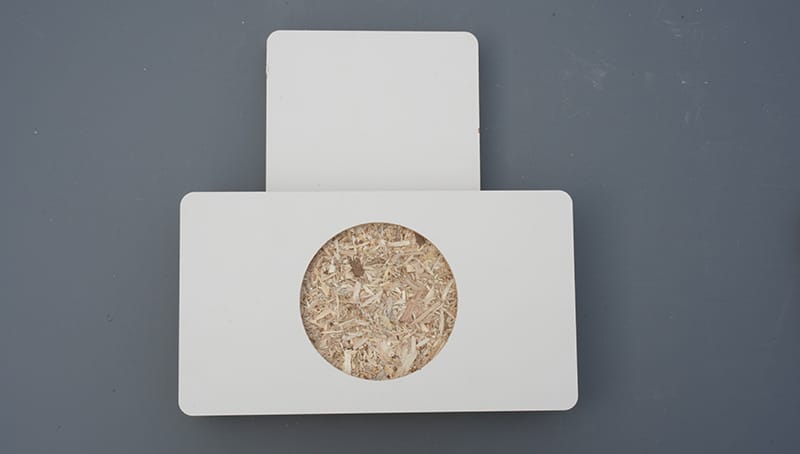
A useful cut sample exposes the surface, edge and full thickness. For medium density fiberboard 4×8, compare that sample with the finished component drawing. Check whether the deepest groove, hinge recess or trimmed edge reaches a part of the core that needs additional preparation. Appearance alone cannot establish the board's moisture, fire or load performance.

Write an RFQ that suppliers can answer consistently
A useful request for quotation describes the intended application, construction, actual dimensions, quantity and delivered condition. For medium density fiberboard 4×8, add the visible faces, exposed edges and required technical evidence. Include drawings where a text description could be interpreted in more than one way, especially for orientation, machining or finished-part dimensions.
Ask each supplier to identify deviations explicitly rather than assume that silence means full agreement. Keep the final written interpretation with the approved sample. When comparing medium density fiberboard 4×8, normalize the quotation basis, packing and delivery scope before ranking offers. This turns the RFQ into a production document that the workshop and receiving team can also use, reducing the chance that purchasing and manufacturing approve different versions of the same item.
Allow for the full finishing sequence
A raw sheet price does not include the work needed to turn it into a paint-ready component. Edge sealing, sanding, primer consumption and drying space can change conversion cost. Compare medium density fiberboard 4×8 using the same finished drawing and finish schedule across candidate boards. Record both material use and labor so a low initial price does not conceal a difficult production process.
Include the corners and recesses that the finishing line handles least easily. When a sample needs extra hand sanding, record that additional work instead of treating it as a one-time exception. A useful quotation for medium density fiberboard 4×8 separates the supplied board from downstream operations and makes clear which party is responsible for final preparation. This keeps purchasing decisions aligned with the workshop's actual workload.
Inspect protection inside the pack
Outer wrapping alone does not prevent internal rubbing, edge impact or uneven support. For medium density fiberboard 4×8, agree on separators, corner protection and pack restraint that suit the delivered construction. Preserve component and lot labels where matched appearance or machining orientation must be maintained.
Request dispatch photographs showing the internal arrangement as well as the closed pack. On arrival, inspect the pack condition before unpacking and check material from more than one position. For medium density fiberboard 4×8, distinguish estimated pack weight from a verified commercial value and confirm handling arrangements with the logistics team. Packaging approval should protect the finished faces and edges without introducing excessive pressure or trapping uncontrolled moisture against a vulnerable surface.
Use the actual hardware in the trial
MDF can be used in many furniture assemblies, but connector performance depends on the board, fastener and joint geometry together. A face screw and a screw driven into an edge are different situations. For medium density fiberboard 4×8, specify the actual hardware, pilot-hole arrangement and installation procedure. Do not transfer a result from a thick offcut to a thin finished component without checking the difference.
Assemble a representative part with normal production equipment. If the furniture must be disassembled, include that operation in the trial and inspect the holes afterward. The approval for medium density fiberboard 4×8 should state the tested arrangement and the permitted component range. Hardware selection based only on panel thickness overlooks door weight, leverage and the local material remaining around recesses.

Make the sample represent the commercial order
A useful sample contains the feature that will drive the buying decision. For medium density fiberboard 4×8, that may be a finished corner, routed profile, connector joint, full-size door or a group of adjacent visible panels. Request material representative of normal production and label it with the construction and source lot.
Run the sample through the same equipment and finish process planned for the order. Record accepted results and any extra labor needed to obtain them. For medium density fiberboard 4×8, a pilot quantity can expose repeatability questions that one hand-prepared swatch cannot. Retain a signed control sample after approval and clarify which changes require a new trial so the initial decision remains useful during subsequent production and repeat purchasing.
Protect edges around cutouts and penetrations
A decorative face does not protect newly cut edges, drilled holes or unfinished returns. In a dry indoor assembly, occasional moisture can still reach these locations during cleaning or through a plumbing leak. When using medium density fiberboard 4×8, identify vulnerable edges on the drawing and specify a compatible treatment rather than leaving protection to an undocumented workshop habit.
Check the complete detail, including edge tape, sealant interfaces and service openings. A moisture-resistant board remains a specified product with defined limitations; it does not make an arbitrary assembly waterproof. For medium density fiberboard 4×8, select the construction for the expected environment and verify it with the supplier's information and an appropriate finished-part trial. Avoid placing vulnerable edges where routine water can collect.
Worked example for cabinet production
Consider an illustrative 1220 × 2440 mm sheet with 10 mm trimmed from every edge. The usable rectangle is 1200 × 2420 mm. For 600 × 400 mm parts and a 3 mm kerf, two 600 mm parts cannot fit across the 1200 mm width because the separating cut also needs space. Rotating the parts permits two 400 mm widths and four 600 mm lengths, giving eight parts in that simple layout. For medium density fiberboard 4×8, use measured sheet dimensions and the permitted orientation. This medium density fiberboard 4×8 example demonstrates why a nominal area calculation is not a verified cutting yield; it does not claim the illustrated layout is globally optimal.
Comparison of three purchasing approaches
| Approach | What it resolves | What remains to check |
|---|---|---|
| Buy from a face sample | Initial color or texture preference | Core, finished detail, component fit and documented use |
| Buy to a written construction | Defined material, dimensions and delivered condition | Whether the workshop can produce the intended finished part |
| Approve a representative finished trial | Construction and processing tested on the relevant component | Commercial-lot consistency and any later material or process changes |
For medium density fiberboard 4×8 in cabinet production, the third approach usually provides the clearest evidence for this decision: allow for saw kerf and edge trimming before counting cabinet components. It also makes the limits explicit. A finished trial covers its documented construction and conditions; it does not qualify every product sold under the same material name.
A practical trial for this order
Identify the requirement: allow for saw kerf and edge trimming before counting cabinet components. Add the drawing revision, intended environment and delivered material construction to the trial record.
Prepare representative medium density fiberboard 4×8 samples from the proposed commercial construction. Include both the visible face and the critical machined or assembled detail.
Run the agreed verification: calculate usable pieces from a full sheet. Use the intended equipment, adjacent components and finishing route so the result represents normal production.
Record acceptance and unresolved questions. Specifically check whether the process risks an oversized offcut allowance hiding poor yield. Keep extra repair or finishing labor visible in the cost comparison.
Retain the approved medium density fiberboard 4×8 sample and transfer the same specification to the purchase order. Review a substitution or changed process before releasing the affected repeat batch.
For background on wood structure, moisture, composite panels, joints and finishing, consult the USDA Forest Products Laboratory Wood Handbook. This independent technical reference supports material understanding; it is not a certification or test report for any DA AO product.
Discuss the specified construction with DA AO
DA AO lists MDF product information within its panel range. Its wood-panel services describe customization of size, thickness, surface finish and decorative pattern. Send the proposed application and drawing so the available construction can be checked against the requirement before quotation.
For a medium density fiberboard 4×8 inquiry about cabinet production, include dimensions, quantity, required finish, exposed edges, hardware or fixing details and the evidence needed for approval. Ask the team to confirm the supplied construction and sample arrangement in writing. Use the inquiry form after the FAQ to request a specification review and a quotation based on the same information.
Frequently asked questions
What is the first check when buying medium density fiberboard 4×8 for this application?
For cabinet production, first allow for saw kerf and edge trimming before counting cabinet components. Identify the supplied construction and put that requirement in the quotation request so the supplier and workshop evaluate the same finished component.
What sample should I request for medium density fiberboard 4×8?
Request representative commercial material, then calculate usable pieces from a full sheet. Keep the drawing, material identity and process conditions with the result. A sample that omits the critical detail cannot establish whether that detail will work in production.
Which mistake should this medium density fiberboard 4×8 order avoid?
Avoid an oversized offcut allowance hiding poor yield. Agree on the intended construction, finished detail and acceptance method before batch processing, then check a representative commercial lot against the retained approval.
Can a supplier substitute another medium density fiberboard 4×8 construction?
Review the proposed change against the signed specification and the critical trial. A matching name or finish does not establish equivalent machining, fit or service behavior. Obtain written approval and repeat the affected evaluation where necessary.
What should a medium density fiberboard 4×8 quotation include?
Include actual dimensions, quantity, supplied finish, packing and delivery basis, together with the requirements for cabinet production. Identify sample approval and any required technical evidence separately so the commercial offer can be compared consistently.