Table of Contents
Introduction
Choosing the right wood panels for furniture manufacturing has a direct impact on machining efficiency, appearance, durability, hardware performance, production consistency, and the final quality of the furniture.
For furniture manufacturers, cabinet factories, interior contractors, distributors, and project buyers, the challenge is not simply finding a board with the correct dimensions. Different furniture components place very different demands on the material. A painted cabinet door may require a smooth and uniform MDF surface, while a wardrobe carcass may perform better with melamine-faced particle board. Structural furniture components may require plywood, while decorative applications may focus more heavily on surface quality and finish consistency.
DA AO Wood supplies a range of wood panel solutions including MDF, particle board, plywood, OSB, melamine-faced boards, and solid wood panels for furniture manufacturing, interior decoration, and other panel-based applications. The most effective material selection therefore begins with the final application rather than with the panel name alone.
Quick Answer: Which Wood Panel Is Best for Furniture?
There is no single wood panel that is best for every type of furniture.
MDF is often preferred for painted surfaces, CNC-routed doors, decorative fronts, and furniture components requiring a smooth finish. Particle board is widely used for wardrobes, cabinet carcasses, shelves, desks, and melamine-faced furniture because it offers efficient processing for standardized panel production. Plywood is usually considered where higher structural strength, repeated fastening, or improved resistance to demanding service conditions is required.
In practical furniture manufacturing, the best specification often combines several wood panels in one product. The important factors are the component’s load, finish, machining process, moisture exposure, hardware system, thickness, and expected service environment.
Wood Panels for Furniture at a Glance
| Panel Type | Best Suited To | Main Advantage | Key Consideration |
|---|---|---|---|
| MDF | Painted doors, decorative fronts, CNC panels | Smooth and uniform surface | Moisture grade must match application |
| Particle Board | Wardrobes, cabinet carcasses, shelving | Efficient for large-volume production | Edge quality and fastener design matter |
| Melamine Particle Board | Cabinets, wardrobes, office furniture | Finished decorative surface | Surface and color consistency are important |
| Plywood | Structural furniture, shelves, frames | Strong layered construction | Grade and veneer structure should be checked |
| OSB | Utility furniture, structural interior uses | Good structural efficiency | Surface appearance may limit decorative uses |
| Solid Wood Panel | Premium furniture and visible components | Natural wood appearance | Movement and moisture conditions must be considered |
This type of component-based selection is more reliable than specifying one material throughout an entire furniture product.
Start With the Furniture Application
The first question should not be:
“Which wood panel is the strongest?”
A better question is:
“What does this furniture component actually need to do?”
For example, a cabinet door must maintain its shape while also accepting paint, decorative profiles, hinges, and repeated opening cycles. A shelf must resist bending over its span. A wardrobe side panel must remain flat and accept hardware consistently. A desk surface may need a decorative finish and edge banding. A hotel furniture project may additionally require repeatability across hundreds of identical units.
These applications have different priorities, so the selected panel should match the component rather than relying on a general material reputation.
Choose MDF for Smooth Surfaces and Decorative Machining
MDF, or medium-density fiberboard, is manufactured from refined wood fibers bonded under heat and pressure. Its relatively homogeneous internal structure gives it a smooth surface and predictable machining behavior.
According to the general description of medium-density fiberboard, MDF is widely used for cabinetry, furniture, molding, and interior applications because it can be machined and finished effectively.
For furniture production, MDF is particularly suitable for:
- Painted cabinet doors
- Decorative furniture fronts
- CNC-routed panels
- Grooved wall panels
- Drawer fronts
- Moldings
- Veneered components
- Interior decorative elements
DA AO’s MDF Medium Density Fiberboard is available in multiple thickness options for furniture, interior decoration, and manufacturing applications, making it useful where different furniture components require different panel dimensions.
When MDF Is the Better Choice
MDF should be strongly considered when surface smoothness is critical.
Painted furniture is a good example. A rough or uneven panel may require additional preparation before priming and coating, while a high-quality MDF surface provides a more consistent base for finishing.
MDF is also useful for detailed machining. CNC routers can produce grooves, profiles, recessed designs, and decorative patterns because the internal fiber structure is relatively uniform throughout the board.
However, furniture buyers should not assume that all MDF is identical. Density, thickness tolerance, moisture grade, surface sanding, internal bond quality, and edge performance can vary between specifications.
Choose Particle Board for Efficient Panel Furniture Production
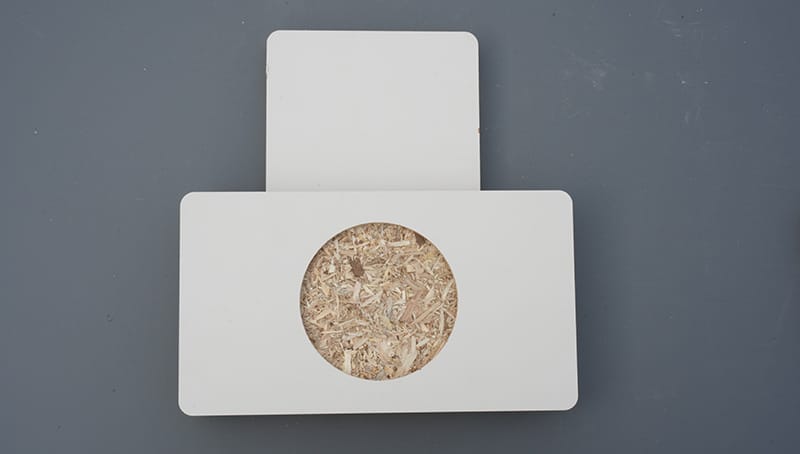
Particle board is produced from wood particles combined with binders and compressed into panel form. It is widely used in modern panel furniture because it works efficiently in standardized manufacturing systems.
The general structure and applications of particle board make it particularly suitable as a core for laminated or melamine-faced furniture panels.
Typical applications include:
- Wardrobe carcasses
- Cabinet bodies
- Shelving
- Office desks
- Storage units
- Drawer components
- Retail fixtures
- Apartment furniture
- Ready-to-assemble furniture
DA AO offers particle board products designed around standardized panel applications, including melamine-faced options for furniture and interior use.
Why Particle Board Works Well in Large-Scale Furniture Production
Furniture factories often process hundreds or thousands of identical components. In this environment, production repeatability becomes extremely important.
A suitable particle board specification can integrate efficiently with:
- Panel saws
- CNC drilling systems
- Edge-banding lines
- Hinge boring machines
- Automated assembly
- Nesting workflows
When the panel is already melamine-faced, manufacturers can move directly into cutting, drilling, edge banding, and assembly without adding a separate decorative finishing process.
This is one reason particle board remains widely used for wardrobes, kitchen carcasses, office furniture, and other standardized panel products.
Choose Plywood When Structural Performance Matters
-3.jpg)
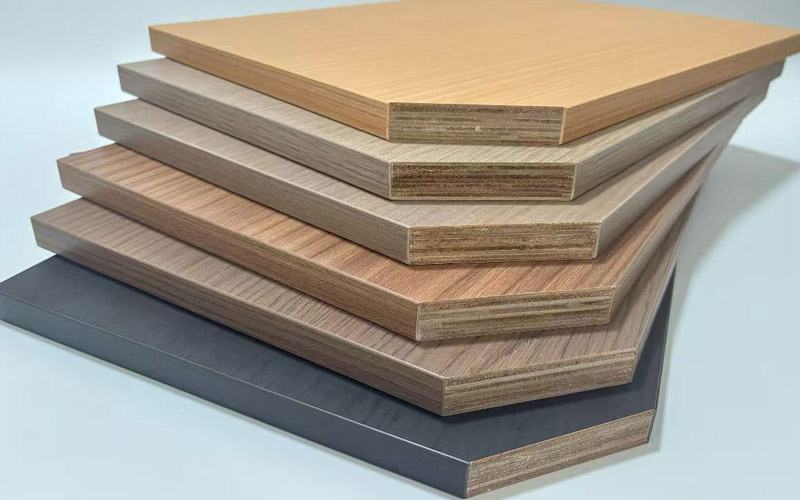
Plywood differs from MDF and particle board because it is manufactured from multiple layers of wood veneer bonded together, with adjacent layers typically arranged in alternating grain directions.
This layered construction gives plywood strong dimensional and structural characteristics.
For furniture manufacturing, plywood may be considered for:
- Load-bearing shelves
- Furniture frames
- Seat structures
- Bed components
- High-strength cabinet sections
- Repeated fastening areas
- Commercial furniture
- Interior construction elements
Plywood can be especially useful when the furniture component must carry higher loads or where screw holding and structural performance are more important than achieving a perfectly smooth painted surface.
However, plywood selection should still consider veneer quality, core construction, thickness, surface grade, glue type, and intended service environment.
What About Melamine-Faced Wood Panels?
Melamine-faced panels are extremely important in modern furniture production because they combine a structural panel core with a decorative finished surface.
The core may be MDF or particle board, while the outer decorative layer provides color, pattern, and surface performance.
These panels are widely used for:
- Wardrobes
- Kitchen cabinets
- Office furniture
- Shelving
- Storage systems
- Interior panels
- Retail fixtures
The key advantage is manufacturing efficiency.
Instead of purchasing a raw board and applying a separate decorative coating, the furniture factory receives a panel that is already finished and ready for cutting, drilling, edge banding, and assembly.
For high-volume furniture production, this can reduce process complexity.
However, buyers must pay attention to more than the decorative appearance. They should also evaluate core quality, thickness tolerance, flatness, surface adhesion, color consistency, edge quality, and batch repeatability.
Match the Panel to the Furniture Component
A common mistake is specifying one material for the entire furniture item.
In many cases, using different materials for different components creates better overall performance.
Consider a kitchen cabinet.
The cabinet may include:
- Doors
- Side panels
- Shelves
- Back panels
- Drawer fronts
- Drawer sides
- Decorative end panels
- Fillers
- Toe kicks
The painted door may use MDF because of its smooth surface and routing capability, while the carcass may use melamine particle board because it is efficient for standardized panel production.
Similarly, plywood may be used only where higher structural performance is required.
The most effective specification is therefore often a mixed-material design.
Wood Panels for Kitchen Cabinets
Kitchen cabinets are one of the most demanding furniture applications because they combine appearance, hardware, moisture exposure, storage loads, and frequent use.
For painted cabinet doors, MDF is often selected because it provides a smooth surface and supports routed profiles.
For carcasses, melamine particle board is commonly used because the decorative finish is already integrated into the panel.
Plywood may also be considered when the design requires higher structural strength or other specific performance characteristics.
Moisture exposure must be evaluated separately. A material being called MDF, plywood, or particle board does not automatically indicate that it is suitable for damp conditions. Buyers should confirm the actual panel grade and moisture-performance specification.
Wood Panels for Wardrobes
Wardrobes usually involve large areas of relatively flat panel components.
Important considerations include:
- Panel flatness
- Thickness consistency
- Edge banding
- Hardware compatibility
- Surface color consistency
- Drilling accuracy
- Shelf loading
Melamine particle board is widely used because it combines a finished decorative surface with efficient industrial processing.
MDF can also be used, particularly for doors, decorative fronts, grooved surfaces, and painted wardrobe components.
For premium wardrobe designs, a combination of MDF and particle board may provide a better balance than using either material exclusively.
Wood Panels for Office Furniture
Office furniture usually requires standardized dimensions, repeatable production, clean edge banding, and durable decorative surfaces.
Particle board and melamine-faced panels are commonly suitable for:
- Desks
- Filing cabinets
- Storage units
- Bookcases
- Partitions
- Workstations
MDF may be introduced when a product requires:
- Decorative profiling
- Painted surfaces
- Curved or routed components
- Premium furniture fronts
The material choice should therefore follow the design language and processing requirements of the furniture system.
Thickness Matters as Much as Material Type
Furniture buyers sometimes focus so heavily on the board type that panel thickness becomes an afterthought.
This is a mistake.
Thickness influences:
- Bending resistance
- Shelf span
- Hardware installation
- Weight
- Edge banding
- Door stability
- Furniture proportions
- Manufacturing compatibility
A thin panel that works well as a cabinet back may not be appropriate for a long shelf.
Likewise, using an unnecessarily thick panel can increase furniture weight and material consumption without producing a meaningful performance benefit.
Panel thickness should therefore be selected according to the function of the component.
Density Is an Important Quality Indicator
Density influences how wood panels behave during machining and assembly.
For MDF, density can affect:
- Routing quality
- Screw holding
- Edge strength
- Surface feel
- Panel weight
- Cutting behavior
For particle board, internal density distribution can affect fastener performance, edge integrity, and machining consistency.
Furniture manufacturers should therefore avoid comparing panels only by nominal dimensions.
Two panels may both be labeled 18 mm, yet behave differently during production because of differences in density profile, internal bonding, raw materials, and manufacturing control.
Check Panel Flatness Before Large-Scale Production
Flatness is especially important for:
- Cabinet doors
- Wardrobes
- Large shelves
- Wall panels
- Desk surfaces
- Long furniture components
A warped panel can create problems during cutting, drilling, edge banding, assembly, and final installation.
For automated furniture factories, inconsistent flatness can also interfere with machine setup and positioning.
This is why panel flatness should be treated as a production parameter, not just a cosmetic issue.
DA AO states that its panel manufacturing focuses on characteristics such as thickness, flatness, density balance, and surface consistency for industrial applications.
Evaluate Surface Quality According to the Finish
The required surface quality depends on how the furniture will be finished.
For painted furniture, the panel surface must support sanding, priming, and coating.
For laminated furniture, adhesion and surface uniformity become important.
For melamine-faced furniture, buyers must check:
- Color consistency
- Surface defects
- Texture
- Pattern repeat
- Scratch resistance requirements
- Adhesion quality
A surface defect that appears minor on a raw panel can become highly visible after finishing.
The panel specification should therefore be linked directly to the intended decorative process.
Consider Screw Holding and Furniture Hardware
Modern furniture relies heavily on mechanical hardware.
Examples include:
- Hinges
- Drawer slides
- Confirmat screws
- Cam connectors
- Shelf supports
- Mounting brackets
The performance of these connections depends on more than the material name.
Important variables include:
- Panel density
- Thickness
- Fastener type
- Pilot hole diameter
- Distance from the edge
- Installation torque
- Expected loading
- Number of assembly cycles
Furniture manufacturers should test their actual hardware system with the intended panel whenever possible.
Moisture Conditions Should Be Defined Early
Water and humidity can influence wood-based panels.
The exact risk depends on panel type, grade, edge sealing, surface treatment, installation environment, and duration of exposure.
Furniture intended for kitchens, bathrooms, laundries, or humid markets requires more careful material selection than furniture installed in dry interior spaces.
Buyers should clarify:
- Indoor environment
- Expected humidity
- Risk of direct water contact
- Edge sealing
- Moisture-resistant grade
- Surface protection
This information should be included when discussing specifications with the panel manufacturer.
Emission Standards and Market Requirements
Furniture manufacturers supplying international markets may also need to comply with specific formaldehyde emission regulations.
For example, the U.S. Environmental Protection Agency’s Formaldehyde Emission Standards for Composite Wood Products apply to products including MDF, particle board, and hardwood plywood sold into the United States.
This means buyers should not evaluate wood panels only according to appearance and mechanical performance.
Depending on the destination market, procurement specifications may also need to define:
- Required emission standard
- Testing requirements
- Certification
- Product labeling
- Documentation
- Traceability
International furniture manufacturers should confirm the applicable regulations before finalizing panel specifications.
What Should Furniture Manufacturers Check Before Selecting a Supplier?
Choosing the right panel is only part of the decision.
For continuous production, supplier consistency is equally important.
Furniture manufacturers should evaluate:
- Product range
- Production capacity
- Thickness consistency
- Panel flatness
- Surface quality
- Density consistency
- Batch repeatability
- Packaging
- Export experience
- Documentation
- Communication
- Supply stability
A sample may perform perfectly while mass-production batches vary significantly.
For this reason, buyers should evaluate both the panel and the manufacturer’s ability to repeat the same specification over time.
Common Mistakes When Choosing Wood Panels
One common mistake is selecting the cheapest panel without considering manufacturing performance.
A low-cost board can become expensive if it creates excessive waste, chipped edges, hardware failures, surface defects, or frequent machine adjustments.
Another mistake is selecting only by panel name.
“18 mm MDF” is not a complete furniture specification.
Depending on the project, buyers may also need to specify:
- Density
- Surface finish
- Moisture grade
- Emission requirement
- Decorative color
- Edge treatment
- Application
- Packaging
- Destination market
A third mistake is using one material throughout the entire furniture product simply for convenience.
Component-based selection usually provides a more efficient balance between performance and material use.
How to Choose the Right Wood Panel Step by Step
A practical furniture panel selection process can follow this sequence:
First, define the furniture component. Determine whether the panel will be used for a door, shelf, carcass, back, drawer, frame, or decorative surface.
Second, identify the main performance requirement. This may be surface smoothness, strength, routing, moisture resistance, edge banding, or cost efficiency.
Third, define thickness and dimensions.
Fourth, determine the finishing method, such as painting, melamine, veneer, laminate, or raw decorative surface.
Fifth, identify hardware and machining requirements.
Sixth, confirm destination-market standards.
Finally, test samples under actual production conditions before committing to large-scale manufacturing.
This process is more reliable than choosing materials according to general descriptions alone.
FAQ
Which wood panel is best for furniture?
There is no single best wood panel for all furniture. MDF is often suited to painted and routed components, particle board works well for standardized melamine furniture, and plywood is useful where higher structural performance is required.
Is MDF good for furniture manufacturing?
Yes. MDF is widely used for furniture because of its smooth surface, consistent structure, and suitability for painting, CNC routing, veneering, and decorative machining.
Is particle board suitable for furniture?
Yes. Particle board is widely used for wardrobes, cabinets, desks, shelves, and storage furniture, particularly when supplied with a melamine decorative surface.
Which wood panel is better for cabinets?
The best choice depends on the cabinet component. MDF is often used for painted or decorative doors, while melamine particle board may be selected for carcasses. Plywood can be considered where additional structural performance is required.
What should I check before buying furniture panels?
Important factors include panel type, thickness, density, flatness, surface quality, edge quality, hardware compatibility, moisture grade, emission requirements, batch consistency, and final application.
Conclusion
Choosing wood panels for furniture manufacturing should always begin with the final application.
MDF, particle board, plywood, and other engineered panels each have different strengths. MDF is especially valuable for smooth painted surfaces and decorative machining. Particle board is highly efficient for standardized melamine furniture production. Plywood provides advantages where structural performance is more important.
For many furniture manufacturers, the best solution is not choosing one panel for everything, but using the most suitable material for each furniture component.
DA AO Wood provides wood panel solutions for furniture manufacturing, cabinets, wardrobes, interior decoration, and project applications, including MDF, particle board, plywood, OSB, melamine-faced boards, and solid wood panels.
For manufacturers, distributors, and project buyers selecting panels for a specific furniture application, you can contact DA AO Wood with your required panel type, thickness, dimensions, finish, application, quantity, and destination market to discuss the appropriate specification.
.jpg)