Table of Contents
Choosing a wood feature wall is no longer only about selecting a color or surface pattern. Buyers now consider board strength, moisture resistance, indoor air quality, installation cost, maintenance requirements, and whether the material supports the overall design concept.
Among the available engineered wood panels, oriented strand board OSB has become an increasingly interesting option for modern interiors. Its layered wood-strand appearance creates a natural yet industrial surface that is difficult to reproduce with conventional decorative boards.
This guide explains how to select OSB for a wooden background wall, feature wall, retail display, office interior, exhibition space, or furniture project.
Key Points Covered in This Guide
- What oriented strand board is and how it is manufactured
- Why OSB is increasingly used for decorative background walls
- How to select the correct OSB grade and thickness
- Whether OSB is suitable for humid indoor environments
- How OSB compares with plywood, MDF, and particle board
- Which surface finishes work best on decorative OSB
- What questions to ask an OSB manufacturer or supplier
- How to calculate quantities and control purchasing costs
- Common OSB wall installation mistakes
- Frequently asked buyer questions about OSB panels
What Is Oriented Strand Board OSB?
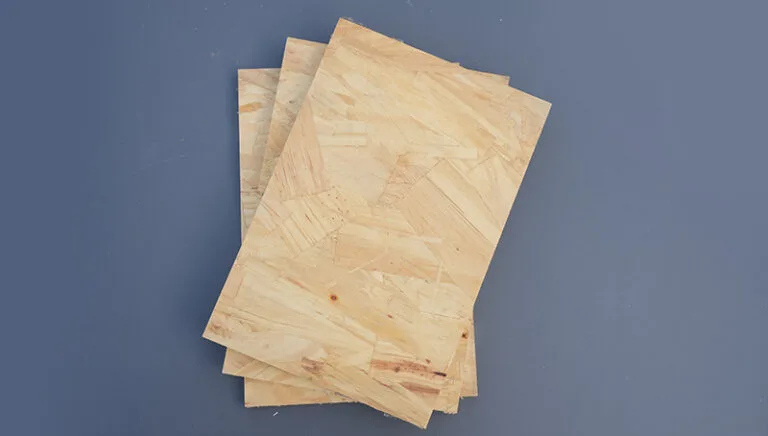
Oriented strand board OSB is an engineered wood panel manufactured from rectangular wood strands arranged in multiple layers. The strands in each layer are generally oriented in different directions before being bonded under heat and pressure.
This cross-oriented structure helps distribute loads across the panel and gives OSB more consistent mechanical performance than randomly arranged particle-based boards. According to APA – The Engineered Wood Association, OSB shares many structural and performance characteristics with plywood.
Wood Strands
Wood strands are longer and more visible than the small particles used in conventional particle board. Their size, shape, direction, and distribution help create both the mechanical structure and recognizable appearance of OSB.
For decorative walls, these strands also become part of the visual design. Each panel has a naturally varied pattern, which gives the finished wall more texture and character.
Cross-Oriented Layers
The outer and inner layers of an OSB panel are arranged in different directions. This structure helps improve panel stiffness, dimensional stability, and strength.
The orientation of the strands is one of the main differences between OSB and ordinary particle board. It is also the reason buyers should not treat all wood-based panels as interchangeable.
Heat-Cured Adhesive
Wood strands are bonded using resin systems activated during hot pressing. The selected adhesive affects moisture resistance, emissions, structural performance, and the intended use of the final panel.
Buyers should request technical information about the adhesive system and applicable emission standards rather than judging a panel only by its appearance.
Pressed Panel Structure
Heat and pressure consolidate the loose strand mat into a solid panel. Manufacturing control influences thickness tolerance, surface quality, density distribution, edge stability, and overall consistency.
For large wall projects, consistent production is important because variations between batches may become visible after installation.
For more background information, readers can also review the general Wikipedia explanation of oriented strand board.
Why Choose Oriented Strand Board OSB for a Wood Background Wall?
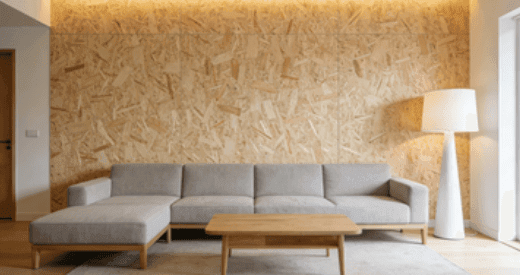
A background wall often acts as the visual center of a room. It may sit behind a reception desk, television, bed, sofa, product display, restaurant counter, or office logo.
The visible strand pattern of oriented strand board OSB can create a distinctive surface without relying on printed wood grain. This makes it particularly attractive for buyers seeking natural variation, industrial styling, or cost-conscious decorative solutions.
A Distinctive Natural Texture
No two OSB panels look completely identical. Strand direction, color variation, and wood density create a layered appearance that feels more authentic than a repetitive printed pattern.
This texture can work especially well in loft interiors, creative offices, cafés, retail stores, workshops, studios, and contemporary residential spaces.
Structural and Decorative Potential
Depending on its grade and specification, OSB can function as more than a decorative skin. It may also support shelving, signage, light storage systems, or display components when properly designed and installed.
However, structural requirements should always be confirmed with an architect, engineer, or local building professional. A visually suitable board is not automatically appropriate for every load-bearing application.
Flexible Finishing Options
OSB can be left exposed, lightly sanded, sealed with a transparent coating, stained, painted, or combined with other materials. Buyers can therefore adjust the surface without completely hiding the strand pattern.
Transparent matte coatings are popular when the goal is to preserve the original appearance. Paint may be more suitable when OSB is used mainly as a textured substrate.
Efficient Use of Wood Resources
OSB manufacturing uses wood strands rather than requiring continuous decorative veneers. This allows manufacturers to use wood resources differently from solid lumber or traditional veneer-based panels.
Environmental performance still depends on raw-material sourcing, resin selection, production efficiency, product lifespan, and end-of-life treatment. Buyers should request supporting documentation before making sustainability claims.
How Do I Choose OSB for My Feature Wall?
The right panel depends on where the wall is located, how much wear it will receive, whether moisture is present, what finish will be applied, and whether anything will be attached to it.
A residential bedroom wall and a busy retail display wall may require different specifications even when both use oriented strand board OSB.
Step 1: Define the Installation Environment
Start by identifying whether the project is located in a dry bedroom, conditioned office, retail store, kitchen, basement, workshop, or other space.
Humidity, temperature changes, cleaning frequency, direct sunlight, and possible water exposure all affect the correct material and finishing system.
Dry Interior Areas
Living rooms, bedrooms, offices, exhibition spaces, and many retail interiors are usually considered dry applications. Decorative OSB can be a practical option when the room remains ventilated and protected from water.
The board should still be acclimated before installation, and its edges should be protected according to the coating and installation plan.
Humid Interior Areas
Kitchens, utility rooms, basements, and some commercial spaces may experience higher humidity. A moisture-resistant specification and properly sealed surface may be required.
OSB should not be described as completely waterproof simply because it contains moisture-resistant resin. Persistent water exposure can still cause edge swelling, staining, or dimensional changes.
Direct Wet Areas
Shower enclosures, continuously wet walls, and unprotected exterior applications require specialized systems. Standard decorative OSB should not be selected as a substitute for a waterproof wall assembly.
Always check local regulations, panel classifications, membranes, joint details, coatings, and ventilation requirements.
Step 2: Select the Appropriate OSB Grade
OSB classifications vary by market and applicable standard. In European-style classifications, buyers may encounter OSB/1, OSB/2, OSB/3, and OSB/4.
The grade should be selected according to the environmental and performance requirements of the project—not simply by choosing the highest or cheapest number.
| OSB Grade | General Description | Typical Environment | Background-Wall Consideration |
|---|---|---|---|
| OSB/1 | General-purpose, non-load-bearing panel | Dry conditions | May suit decorative dry interiors |
| OSB/2 | Load-bearing panel | Dry conditions | Useful when additional strength is required |
| OSB/3 | Load-bearing, moisture-resistant panel | Humid conditions | Common option for more demanding interiors |
| OSB/4 | Heavy-duty load-bearing panel | Humid conditions | Usually selected for higher structural demands |
These descriptions are simplified. Buyers should confirm the exact standard, test method, certification, and intended application with the supplier.
Step 3: Choose the Correct OSB Thickness
OSB thickness influences rigidity, weight, fastening performance, cost, transport efficiency, and the final wall depth. Thicker does not automatically mean better for every project.
For a purely decorative lining fixed to a stable substrate, a relatively thin panel may be sufficient. For freestanding partitions, shelving supports, or walls receiving mounted fixtures, a thicker structural panel may be necessary.
Thin Decorative Panels
Thinner panels can reduce material weight and may be easier to handle. They are often considered for decorative overlays where a continuous backing structure already exists.
They may require closer support spacing and careful fastening to prevent movement or surface distortion.
Medium-Thickness Panels
Medium thicknesses offer a balance between handling, rigidity, and fastening capacity. They are commonly evaluated for residential and commercial wall lining projects.
The correct thickness still depends on stud spacing, substrate condition, panel size, fixing method, and local construction practice.
Thick Structural Panels
Thicker OSB provides greater stiffness but adds weight, material cost, and wall depth. It may be useful when the wall must support fixtures or contribute to an engineered assembly.
Heavy panels also require appropriate handling equipment, fasteners, and supporting framing.
Step 4: Evaluate the Surface Appearance
When OSB remains visible, surface selection becomes as important as structural performance. Buyers should review actual panel samples rather than relying only on catalog photographs.
Strand size, color distribution, sanding quality, pressing marks, knots, resin spots, and batch variation can all affect the final appearance.
Fine-Strand Appearance
Panels with a more refined surface may create a cleaner and more uniform decorative wall. They can be appropriate for modern offices, furniture, retail interiors, and residential feature walls.
A finer appearance may also simplify light sanding and clear coating.
Coarse-Strand Appearance
Larger visible strands create a stronger industrial character. They are often preferred in workshops, studios, cafés, exhibition stands, and raw-material-inspired interiors.
The visual pattern can be highly attractive, but buyers should confirm that the surface is suitable for the intended coating and cleaning method.
Sanded OSB
Sanded OSB provides a more even surface and may improve coating consistency. It can also reduce raised fibers that might otherwise collect dust or feel rough to the touch.
Excessive sanding on site should be avoided because it may alter panel thickness and surface performance.
Step 5: Check Indoor Emission Requirements
For interior applications, buyers should ask about formaldehyde emissions, volatile organic compounds, resin type, and relevant test reports.
Requirements may differ between countries, building types, retailers, and project owners. Schools, healthcare environments, hotels, and residential developments may have stricter procurement standards.
Emission Classification
An emission classification indicates that the panel has been tested under a defined method. Buyers should check which standard was used, who performed the testing, and whether the report applies to the exact product being purchased.
A general marketing statement should not replace current technical documentation.
Chain-of-Custody Documentation
Some projects request traceability or responsible sourcing documentation. Certification requirements should be discussed before production because they may affect raw-material selection, labeling, documentation, lead time, and price.
Buyers should clearly state whether certification is mandatory or simply preferred.
OSB vs Plywood vs MDF vs Particle Board
There is no single wood panel that is best for every wall. Material selection should reflect appearance, strength, machining, finishing, moisture exposure, and budget.
The following comparison provides a practical starting point.
| Material | Visible Appearance | Structural Potential | Surface Smoothness | Moisture Consideration | Common Wall Use |
| OSB | Visible layered strands | High, depending on grade | Medium | Grade-dependent | Industrial and natural feature walls |
| Plywood | Veneer grain and layered edges | High | Medium to high | Type-dependent | Premium walls and structural lining |
| MDF | Uniform fiber surface | Low to medium | Very high | Standard MDF is moisture-sensitive | Painted and routed decorative walls |
| Particle Board | Fine particle structure | Low to medium | Smooth with overlay | Usually intended for dry interiors | Laminated furniture and wall systems |
| Solid Wood Board | Natural continuous grain | Application-dependent | Variable | Species and finish-dependent | Premium natural wall cladding |
Oriented Strand Board OSB vs Plywood
OSB uses oriented wood strands, while plywood uses thin wood veneers arranged in cross-laminated layers. Both materials can provide strong panel performance when manufactured to an appropriate structural specification.
Choose OSB when you want a bold strand texture, consistent panel structure, and an engineered appearance. Choose plywood when visible veneer grain, exposed layered edges, or conventional woodworking aesthetics are more important.
DA AO Wood Industry supplies both oriented strand board OSB and other wood-based panels, allowing project buyers to compare materials according to their intended application.
Oriented Strand Board OSB vs MDF
MDF is manufactured from fine wood fibers and is known for its smooth, consistent surface. It is commonly selected for painted panels, routed patterns, exhibition props, decorative furniture, and detailed machining.
OSB is generally the more distinctive option when the board itself will become part of the design. MDF is often more suitable when the surface will be completely painted or covered.
Buyers considering a smooth decorative substrate can review the company’s MDF medium-density fiberboard range.
Oriented Strand Board OSB vs Particle Board
Particle board is manufactured using smaller wood particles and is widely used as a substrate for furniture and decorative overlays. It typically has a more uniform internal appearance but does not offer the same visible strand structure as OSB.
Choose OSB for a textured feature wall or an application requiring greater panel stiffness. Choose particle board when a smooth laminated surface and cost-efficient furniture production are the main priorities.
The particle board product category provides another option for indoor furniture and panel applications.
Oriented Strand Board OSB vs Solid Wood
Solid wood offers natural grain continuity and can create a premium interior. However, species selection, moisture content, board width, dimensional movement, grading, and cost must all be considered.
OSB creates a different design language. It looks engineered rather than traditional and may provide greater visual consistency across large wall areas.
Which Finish Is Best for an OSB Background Wall?
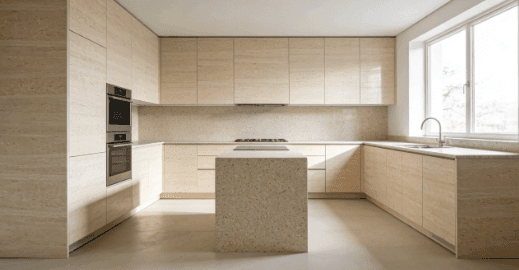
The finish determines how the panel looks, feels, and performs during use. A suitable finish can reduce dust collection, improve cleanability, control color, and provide additional surface protection.
Test the finish on a representative sample before coating the full wall. Wood strands and resin-rich areas may absorb coatings differently.
Clear Matte Sealer
A clear matte sealer preserves the original appearance while reducing surface roughness and improving cleanability. It is one of the most suitable options for maintaining the natural OSB texture.
The coating must be compatible with the panel and should be applied according to the manufacturer’s recommended coverage and drying conditions.
Clear Satin or Gloss Coating
Satin and gloss coatings make the surface more reflective and may increase color contrast between strands. They can work well in retail, hospitality, or exhibition spaces where stronger visual impact is desired.
Glossy finishes may also highlight surface unevenness, so sample approval is especially important.
Wood Stain
A transparent or semi-transparent stain can shift the color while preserving part of the strand pattern. Grey, brown, black, and warm natural tones are common options for modern interiors.
Because OSB absorbs stain unevenly, the result may be more varied than stained solid wood or veneer.
Paint
Paint can unify the panel color while leaving part of its surface texture visible. White, black, muted green, grey, and earthy tones can create very different effects.
Primer selection is important because untreated wood strands and resin areas may influence coverage and adhesion.
Decorative Overlay
OSB can sometimes serve as a substrate beneath a decorative surface. This may be considered when buyers want panel rigidity but do not want an exposed strand pattern.
For comparisons between decorative surfaces, see DA AO Wood Industry’s article on melamine wood panels vs laminated boards.
What OSB Color Works Best for a Feature Wall?
The natural color of OSB usually includes warm wood tones, pale strands, darker flakes, and visible resin variation. Its final appearance changes significantly under different lighting and coatings.
Color selection should therefore be tested within the actual room rather than chosen from a digital image alone.
Natural OSB with Black Details
Natural OSB pairs well with black metal shelves, frames, lighting tracks, signage, and furniture. The combination creates an industrial or workshop-inspired interior.
It is particularly effective in creative offices, studios, stores, and modern cafés.
OSB with White Surfaces
White ceilings, walls, and furniture can balance the visual activity of the strand pattern. This combination creates a brighter and more contemporary space.
Using OSB on only one wall can prevent the room from feeling visually overloaded.
OSB with Green Plants
Natural greenery softens the engineered appearance of OSB and introduces additional texture. Plants, warm lighting, and neutral fabrics can make the space feel more comfortable and less industrial.
The wall should still be protected from irrigation water and persistent moisture.
Dark-Stained OSB
A dark stain can create a sophisticated wall while keeping the strand pattern partially visible. This approach works well behind reception desks, product displays, bars, and branded signage.
Always test dark coatings because absorption differences can produce strong tonal variation.
For more design inspiration, see 7 Stunning Wooden Panel Trends for 2026 Homes and the guide to 2026 wall panelling trends.
How Should Oriented Strand Board OSB Be Installed?
Correct installation protects both appearance and performance. Panels should not be attached to a wall without checking moisture conditions, support spacing, expansion requirements, fastener selection, and finishing details.
Installation recommendations can vary by product, panel thickness, project type, and local construction rules.
Acclimate the Panels
Panels should be stored in the installation environment or under comparable conditions before fitting when recommended by the supplier. This allows the material to adjust to local temperature and humidity.
Keep the boards flat, dry, supported, and protected from direct contact with floors or wet surfaces.
Inspect the Supporting Wall
The substrate or framing should be level, stable, dry, and capable of supporting the panel weight. Uneven support can cause visible joints, movement, or fastening problems.
Any moisture source behind the wall should be corrected before installation.
Plan the Panel Layout
Decide whether the wall will use full-size sheets, equal modules, staggered joints, narrow strips, or a decorative geometric layout. The arrangement should be planned around doors, sockets, corners, shelves, and signage.
Dry-layout planning also helps distribute strand patterns more evenly across the wall.
Allow for Panel Movement
Wood-based panels respond to changes in environmental conditions. Appropriate gaps may be required between panels and around the perimeter.
Follow the manufacturer’s installation instructions and applicable building practices rather than fitting panels tightly without allowance.
Use Suitable Fasteners
Screws, nails, concealed clips, or adhesive-assisted systems may be used depending on the wall construction. Fasteners must be compatible with the substrate, panel thickness, expected load, and desired appearance.
Visible black screws can become part of an industrial design, while concealed fixing may be preferred for cleaner interiors.
Seal Cut Edges
Cut edges can absorb moisture more readily than factory surfaces. Sealing may be necessary, especially near floors, worktops, windows, kitchens, or other areas with occasional moisture.
Edge treatment also improves the visual quality of exposed panel joints.
Common OSB Wall-Buying Mistakes
Even a high-quality panel can perform poorly when the specification does not match the project. Many problems begin during purchasing rather than installation.
Buying by Price Alone
The lowest quotation may exclude important requirements such as sanding, emission testing, moisture-resistant grade, special packaging, edge protection, or certification.
Compare specifications line by line rather than comparing only the price per sheet or cubic meter.
Assuming All OSB Is Waterproof
Moisture-resistant does not mean permanently waterproof. OSB grade, resin, edge treatment, coating, ventilation, and wall assembly all influence moisture performance.
Ask the supplier to define the recommended use conditions clearly.
Ignoring Batch Variation
Visible OSB walls may show differences in strand color and pattern between production batches. Ordering the full project quantity together can improve visual consistency.
It is also useful to approve samples and agree on acceptable appearance criteria before mass production.
Choosing Thickness Without Checking Framing
A panel that appears rigid in a small sample may behave differently across wide support spacing. Thickness should be coordinated with wall framing and intended loads.
For mounted cabinets, shelves, televisions, or signage, obtain professional fastening and structural advice.
Applying Finish Without Testing
Clear coatings, stains, primers, and paints may react differently across the OSB surface. A small test area helps identify absorption, color shift, gloss level, drying time, and possible adhesion issues.
The sample should use the same preparation and coating process planned for the final wall.
How Much Oriented Strand Board OSB Do I Need?
To estimate the quantity, first calculate the total wall area and subtract large openings such as doors or windows. Then divide the net wall area by the usable area of one panel.
Add an allowance for cutting, pattern matching, damage, and future repairs.
Basic Quantity Formula
Required panels = Net wall area ÷ Usable panel area
After calculating the basic number, add a waste allowance. A straightforward modular wall may need less additional material than a complex wall with many corners, sockets, angled cuts, or pattern-matching requirements.
Example Calculation
Suppose a wall is 5 meters wide and 2.8 meters high:
- Gross wall area: 5 × 2.8 = 14 square meters
- Door opening: 2 square meters
- Net wall area: 12 square meters
- Panel size: 1.22 × 2.44 meters
- Approximate panel area: 2.98 square meters
- Basic quantity: 12 ÷ 2.98 = approximately 4.03 panels
The mathematical minimum is slightly more than four panels, but the actual order should include cutting and waste. The layout may require five or more panels depending on joint positions and panel orientation.
How to Choose a Reliable OSB Supplier
A reliable supplier should help buyers understand specifications rather than simply provide a unit price. This is especially important for international projects involving custom sizes, packaging, documentation, and container loading.
DA AO Wood Industry presents a range of factory-direct wood panels, including OSB, MDF, plywood, particle board, eco-friendly board, and solid wood board. Buyers can explore the complete product range on the DA AO Wood Industry homepage.
Request a Complete Specification Sheet
The document should identify panel dimensions, thickness tolerance, grade, surface treatment, density or relevant performance information, intended application, and applicable standards.
Confirm that the specification sheet refers to the same product included in the quotation.
Ask for Representative Samples
A small sample allows buyers to assess strand appearance, surface texture, machining, edge quality, coating response, and color variation.
For visible wall projects, sample approval should cover both technical and aesthetic requirements.
Confirm Minimum Order Quantity
Minimum order quantity may depend on thickness, dimensions, grade, surface treatment, packaging, and whether the product is a standard or custom specification.
Buyers should also ask whether different sizes or thicknesses can be combined in one shipment.
Review Packaging and Edge Protection
Export packaging should protect panels from moisture, dirt, impact, and edge damage during handling and transportation.
Discuss pallet structure, wrapping, corner protection, labeling, loading method, and storage requirements before shipment.
Verify Documentation Requirements
Different markets and projects may request invoices, packing lists, certificates of origin, test reports, fumigation-related documents, or sourcing certifications.
Provide the required document list early so the supplier can confirm availability and lead time.
Discuss Production and Delivery Time
Ask whether the quoted lead time begins after deposit, sample approval, specification confirmation, or packaging confirmation.
For scheduled construction projects, include time for production, inspection, transport, customs clearance, and local delivery.
Buyer Checklist for Oriented Strand Board OSB
Before placing an order, confirm the following information:
- Intended wall application
- Indoor humidity and possible water exposure
- Required OSB grade
- Panel thickness
- Length and width
- Sanded or unsanded surface
- Visible strand appearance
- Clear coating, stain, paint, or overlay
- Emission requirements
- Certification requirements
- Quantity and waste allowance
- Edge treatment
- Packaging method
- Sample approval process
- Lead time
- Shipping terms
- Required export documents
A detailed inquiry helps the manufacturer recommend a more accurate product and reduces misunderstandings during production.
FAQ About Oriented Strand Board OSB
Is OSB good for an interior feature wall?
Yes, OSB can be a practical material for an interior feature wall when the grade, thickness, surface, and finish match the environment. Its visible strands create a distinctive natural-industrial appearance.
For occupied interiors, buyers should also review emission documentation, surface sealing, edge treatment, and local building requirements.
Can I use oriented strand board OSB behind a TV?
OSB may be used as a decorative wall behind a television, but the complete installation must account for mounting loads, heat ventilation, cable management, fire-safety requirements, and support framing.
Do not rely only on the visible panel to carry a wall-mounted television. Fasteners should connect to an appropriate structural support system.
What thickness of OSB should I use for a wall?
The correct thickness depends on whether the panel is decorative or structural, the support spacing, the panel dimensions, and whether objects will be attached.
A supplier or construction professional should review the wall assembly before confirming the thickness.
Is OSB waterproof enough for a bathroom wall?
Standard OSB should not be treated as a waterproof bathroom finish. Moisture-resistant grades may tolerate humid conditions better, but direct wet zones require a properly designed waterproofing system.
For bathroom use, check local codes and obtain professional advice about membranes, ventilation, joints, edges, and surface coatings.
Does OSB need to be sealed indoors?
Exposed OSB is often sealed to improve cleanability, reduce raised fibers, control staining, and protect the visible surface. A sealer can also make the strand pattern easier to maintain.
The coating should be tested on a sample because different areas of the panel may absorb it unevenly.
Can I paint directly over OSB?
OSB can be painted, but surface preparation and primer selection are important. Dust, loose fibers, resin-rich areas, and uneven absorption can affect the finish.
Light sanding, cleaning, priming, and sample testing normally produce better results than applying the final paint directly.
Is OSB cheaper than plywood?
OSB is often selected as a cost-efficient alternative to plywood, but actual pricing varies by country, grade, thickness, panel size, certification, order quantity, and market conditions.
Buyers should compare the complete installed cost rather than the panel price alone.
Which is better for a feature wall: OSB or MDF?
Choose OSB when you want visible wood strands, stronger texture, and an industrial appearance. Choose MDF when you need a very smooth surface for painting, routing, or detailed decorative machining.
The better option depends on the desired appearance and functional requirements.
Can shelves be attached to an OSB wall?
Light items may be attached to an appropriately specified and installed OSB assembly, but safe capacity depends on panel thickness, grade, fasteners, framing, shelf design, and load distribution.
Heavy shelves should be fixed into suitable structural supports, not only into a decorative panel.
How do I make an OSB wall look more expensive?
Use carefully selected panels, align the strand patterns, plan symmetrical joints, finish cut edges, apply a high-quality matte or satin coating, and coordinate the wall with lighting, metal details, plants, or neutral furniture.
Precise installation usually has a greater visual impact than simply choosing a darker or more expensive coating.
Is oriented strand board OSB environmentally friendly?
OSB can make efficient use of wood strands, but environmental performance depends on forest sourcing, resin chemistry, manufacturing efficiency, transport distance, service life, certification, and disposal.
Buyers should request verifiable sourcing and emission documents instead of relying on broad environmental claims.
Where can I buy OSB panels in bulk?
Contractors, distributors, furniture manufacturers, interior companies, and project buyers can purchase OSB directly from a qualified wood-panel manufacturer or exporter.
For product specifications, samples, packaging options, and wholesale inquiries, visit the DA AO oriented strand board product page or submit an inquiry through the company website.
Final Thoughts
The best wooden background wall is not necessarily made from the most expensive material. It is made from a panel whose appearance, grade, thickness, moisture performance, finish, installation method, and documentation match the project.
Oriented strand board OSB is particularly suitable for buyers who want a strong visual texture, flexible finishing options, and an engineered wood aesthetic. It can work in residential interiors, offices, shops, cafés, studios, exhibitions, furniture, and other decorative environments when correctly specified.
Before purchasing, define the installation conditions, request technical documents, inspect representative samples, test the selected coating, and confirm the complete wall system with qualified professionals.
To discuss dimensions, grades, samples, wholesale quantities, or export packaging, explore the DA AO Wood Industry OSB range and request a project-specific quotation.
Thank you for reading!
I’m glad you joined me on this journey. If you found this content useful or interesting, I would love to hear your thoughts.
- Follow me on Facebook for tips, updates, and community discussions.
Click here to connect - Subscribe to my YouTube channel for tutorials, demonstrations, and practical insights.
Click here to subscribe
Feel free to share your feedback or questions in the comments or on social media. Let’s keep learning and growing together!
.jpg)